

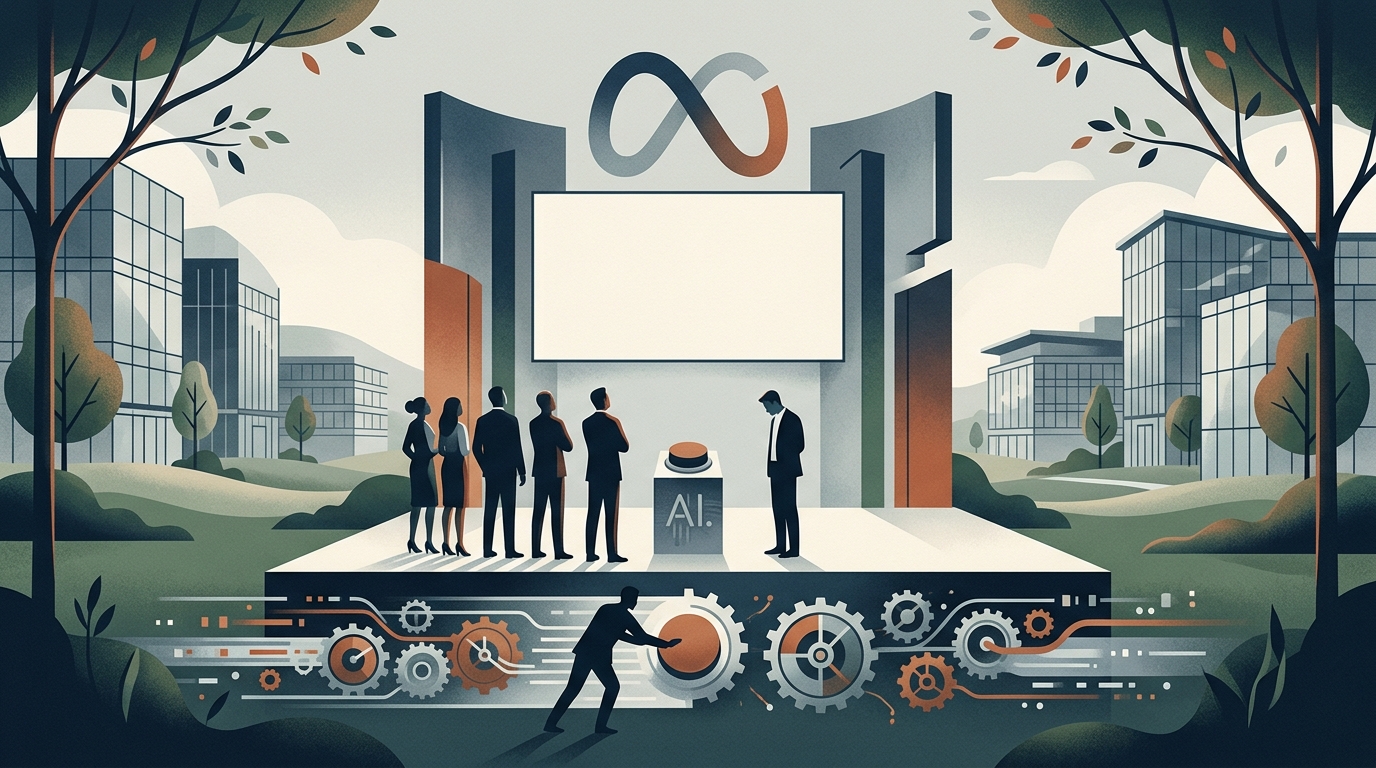
In a rare moment of self-reflection echoing through the halls of Silicon Valley, Mark Zuckerberg recently admitted that Meta’s ambitious AI-centric reorganization has yet to bear the expected fruit. As we move through the summer of 2026, Meta stands at a critical juncture, attempting to transform itself from a social media titan into a company defined by computational intelligence.
The Anatomy of an Unfinished Transition
Meta’s strategy over the last two years has been clear: merging its Fundamental AI Research (FAIR) units with product teams managing Facebook, Instagram, and WhatsApp. The goal was to accelerate the integration of Llama models into the daily user experience. However, Zuckerberg noted that the "friction" between pure research and commercial application remains higher than anticipated. The bureaucracy inherent in a company of over 60,000 employees appears to be stifling the agility required in the Generative AI sector.
According to internal sources, the difficulty lies not just in the technology, but in the culture. Engineers trained to optimize algorithms for user engagement are struggling to adapt to the demands of training massive language models, which require a different approach to data management and compute power.
The Infrastructure War and the Cost of Dominance
Despite admitting to delays in meeting goals, Meta continues to invest astronomical sums in infrastructure. Building new data centers and purchasing hundreds of thousands of Nvidia’s H200 and Blackwell chips has sent capital expenditures skyrocketing. Zuckerberg argues that infrastructure is the "foundation" and that the reorganization will bear fruit once the full transition to a unified AI architecture for all company apps is complete.
- Unifying data silos remains the largest technical hurdle.
- Competition for talent from OpenAI and Anthropic has increased retention costs.
- The Open Source strategy (Llama) builds an ecosystem but does not generate immediate revenue.
"This isn't just about building a chatbot. It's about restructuring how our entire social ecosystem functions," Zuckerberg stated in a recent interview.
The 2026 Challenge: From Hype to Reality
2026 is being viewed as the year of reckoning for Meta. Investors are beginning to show signs of fatigue from constant promises of future AI profits, while the Metaverse remains a costly "black hole." The admission that the reorganization hasn't yet delivered is an attempt by Zuckerberg to manage Wall Street’s expectations, asking for more time to prove that Meta can dominate this new era.
Meta’s strategy of offering its models for free as open source has disrupted the market, but internal utilization of these models to create new revenue streams—beyond advertising—remains the great unknown. If the reorganization is not successfully completed within the next year, pressure for leadership changes or drastic spending cuts will become suffocating.
Conclusion
Meta is currently in a phase of "digesting" the massive changes it attempted. Mark Zuckerberg is betting everything on AI, but the reality of managing a global giant is proving more complex than the code of a model. The success or failure of this reorganization will determine whether Meta remains a protagonist or becomes an infrastructure of the past.





