

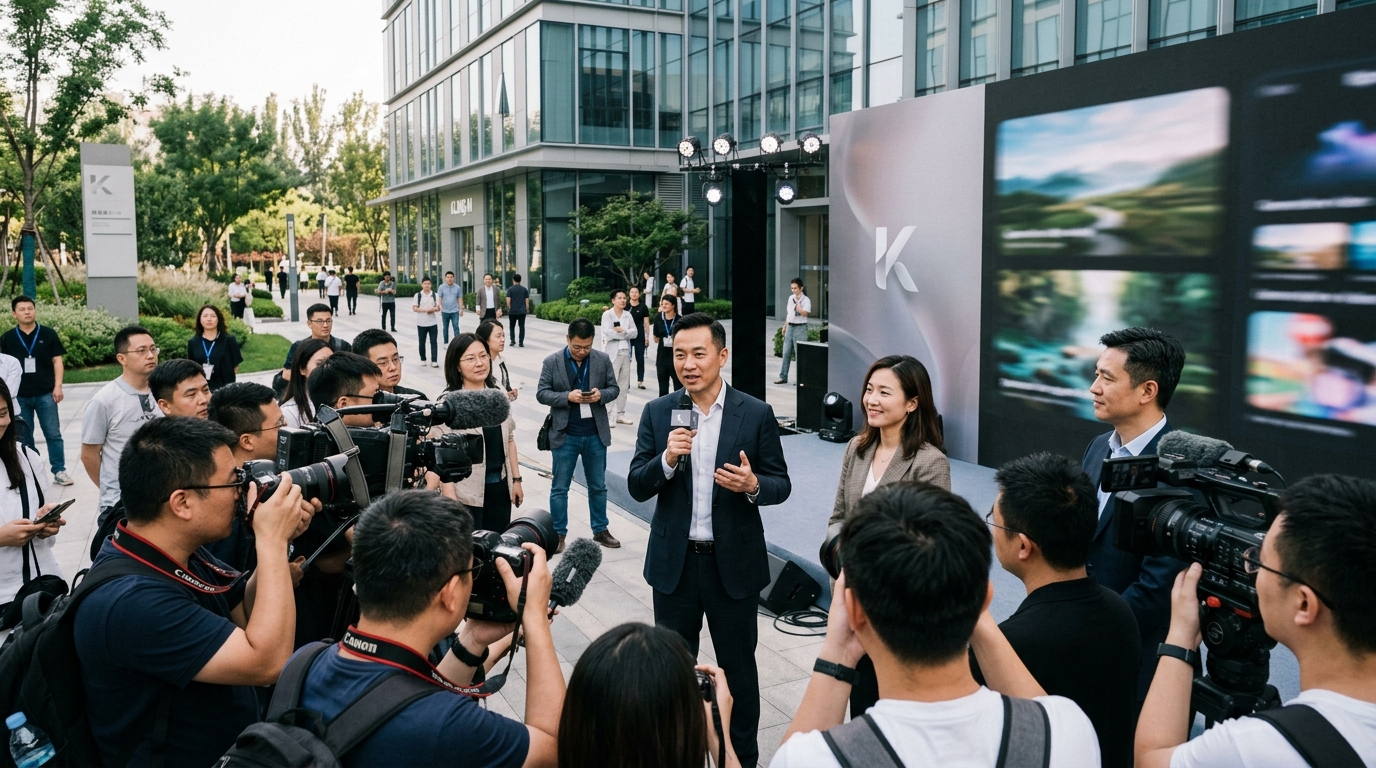
In a move that fundamentally redraws the global AI landscape, Kling AI, the Chinese powerhouse in generative video, has announced the closing of a monumental $2.8 billion funding round. This capital injection catapults the company’s valuation to a staggering $18 billion, establishing it as one of the most valuable AI startups in existence. The fact that this round is led by China’s twin tech titans, Alibaba and Tencent, underscores the strategic weight Kling AI carries for Beijing’s national technological sovereignty.
A Strategic Alliance of Titans
The joint participation of Alibaba and Tencent is a rare sight in the tech world. Historically, these two conglomerates have been fierce rivals, competing for dominance in everything from fintech to gaming. However, the imperative to build a robust Chinese counterweight to OpenAI’s Sora has catalyzed this unusual alliance. Kling AI, which originated within Kuaishou before being spun off, has already demonstrated high-definition video generation capabilities that many analysts believe rival or even surpass Western benchmarks.
This investment is about far more than just cash. Alibaba provides Kling AI with access to its massive cloud computing infrastructure, essential for training large-scale models. Meanwhile, Tencent offers a peerless distribution ecosystem through its social networks and media platforms. This vertical integration provides Kling with a competitive moat that few Western startups can match, blending cutting-edge research with unlimited compute and immediate access to hundreds of millions of end-users.
Technical Prowess and Physical Simulation
What sets Kling AI apart from its competitors is its sophisticated understanding of physical laws. The model can generate videos up to two minutes long in 1080p resolution at 30fps, maintaining a level of temporal consistency that was previously thought unattainable. Whether it is the fluid dynamics of pouring water or the nuanced micro-expressions of a human face, Kling AI appears to have solved fundamental challenges that still plague other generative video models.
- Video Duration: Capable of producing long-form, continuous scenes without significant quality degradation.
- Physics Engine: Realistic interaction between objects, lighting, and environments.
- Multimodality: Seamless integration of text, image, and audio prompts to create comprehensive cinematic experiences.
- Efficiency: Optimized architectures that deliver high-quality output with lower latency than many current alternatives.
This technological leap comes at a time when the global creative industry is watching with bated breath. From Hollywood studios to advertising agencies in London and Tokyo, the ability to generate high-fidelity content at a fraction of the traditional cost promises—or threatens—to disrupt every aspect of media production.
Geopolitical Implications and the Race for Algorithmic Supremacy
The funding of Kling AI cannot be viewed in isolation from the broader geopolitical context. As the United States tightens export controls on advanced AI chips, Beijing is responding by doubling down on domestic champions. Kling AI’s success is a potent statement of intent: China does not intend to merely follow the West; it intends to lead. By fostering companies that can innovate despite hardware constraints, China is building a resilient AI ecosystem that is increasingly decoupled from Western dependencies.
"The battle for Generative AI is the space race of the 21st century. Whoever controls the creation of the digital world will control the narrative of reality," noted a senior tech strategist based in Beijing.
However, significant hurdles remain. Kling AI must navigate a minefield of intellectual property concerns and ethical dilemmas, particularly regarding the potential for deepfakes and misinformation. Furthermore, a heavy reliance on the domestic Chinese market could limit its global reach if Western regulators decide to restrict the use of Chinese AI models citing national security concerns. The "Great Firewall" of AI may soon work both ways.
The Future of Creativity and Capital
As Kling AI prepares for its next phase of expansion, the question is no longer whether AI will replace creators, but which creators will master these tools first. With $2.8 billion in its coffers, the company has the resources to poach global talent and continue pushing the boundaries of what is possible. The era of "democratized cinema" is fast approaching, but it arrives with a distinct signature of Chinese technological might, challenging the Silicon Valley status quo.





