

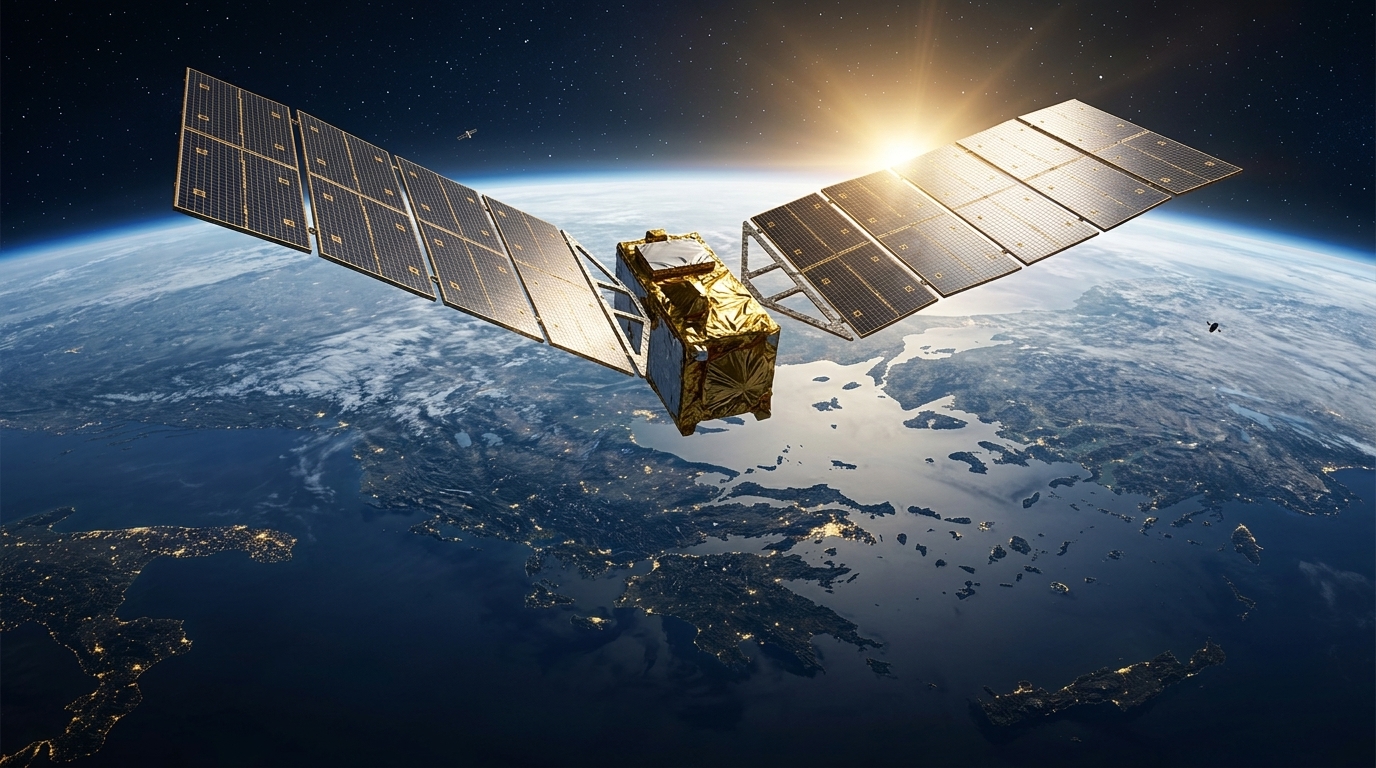
In today's geopolitical and economic landscape, sovereignty is no longer contested only on land or at sea, but also in Low Earth Orbit (LEO). ICEYE, the Finnish pioneer in Synthetic Aperture Radar (SAR) technology, is once again at the center of global attention. Following the signing of a historic agreement with the Greek government to create a national satellite observation system, the company is now seeking a massive new funding round expected to skyrocket its valuation, confirming the momentum of the so-called "NewSpace" economy.
The Strategic Importance of SAR Technology
For the uninitiated, SAR technology might sound like just another piece of specialized scientific jargon. In reality, however, it is the "eye that never sleeps." Unlike traditional optical satellites that rely on sunlight and are obstructed by clouds or night, ICEYE's satellites use radar waves. This allows them to "see" through thick cloud cover, wildfire smoke, and even total darkness, providing high-resolution imagery in real-time.
This capability is what made ICEYE indispensable on battlefields like Ukraine, as well as in natural disaster scenarios. For Greece, a country frequently hit by wildfires and floods, access to such data is not a luxury but a matter of national security and civil protection.
The Greek Bet and National Sovereignty
Greece's deal with ICEYE, largely funded by the Recovery and Resilience Fund (RRF), provides for the construction and launch of satellites that will exclusively serve Greek needs. This move aims to reduce the country's dependence on foreign data providers and create a domestic space technology ecosystem.
According to analysts, the selection of ICEYE by the Ministry of Digital Governance and the Hellenic Space Center (HSC) was based on the company's proven ability to develop microsatellites at a fraction of the cost of traditional aerospace giants. The new funding sought by the company will allow it to accelerate production and further improve the resolution of its imagery, offering Greece even more precise data for border surveillance and crisis management.
Economic Implications and the Road to Unicorn Status
ICEYE is no longer just a startup. With the current fundraising effort, the company aims to double its valuation, approaching or even exceeding the "unicorn" threshold under terms reminiscent of Silicon Valley's golden eras. Investor confidence stems from the fact that ICEYE has managed to turn a highly complex technology into a profitable business model based on contracts with governments and major insurance companies.
- Government Contracts: Steady revenue through long-term agreements for national security.
- Insurance Sector: Immediate assessment of flood damage worldwide, reducing claim times.
- Environmental Surveillance: Monitoring climate change and illegal logging.
"Space technology is no longer the privilege of superpowers. It is the tool of agile nations that understand that information is the most valuable currency of the 21st century," say sources close to the company.
Challenges and Competition
Despite its success, the path is not without obstacles. Competition from companies like Capella Space and Umbra is intensifying. At the same time, geopolitical instability can affect supply chains for critical satellite components. However, ICEYE maintains its first-mover advantage in Europe, having built close ties with the European Space Agency (ESA) and national governments like Greece.
In conclusion, ICEYE's new funding is a vote of confidence not only in the company itself but also in the vision of a Europe investing in its own space infrastructure. For Greece, ICEYE's success is inextricably linked to the success of its own national program, signaling the country's entry into a new era of technological autonomy.





