

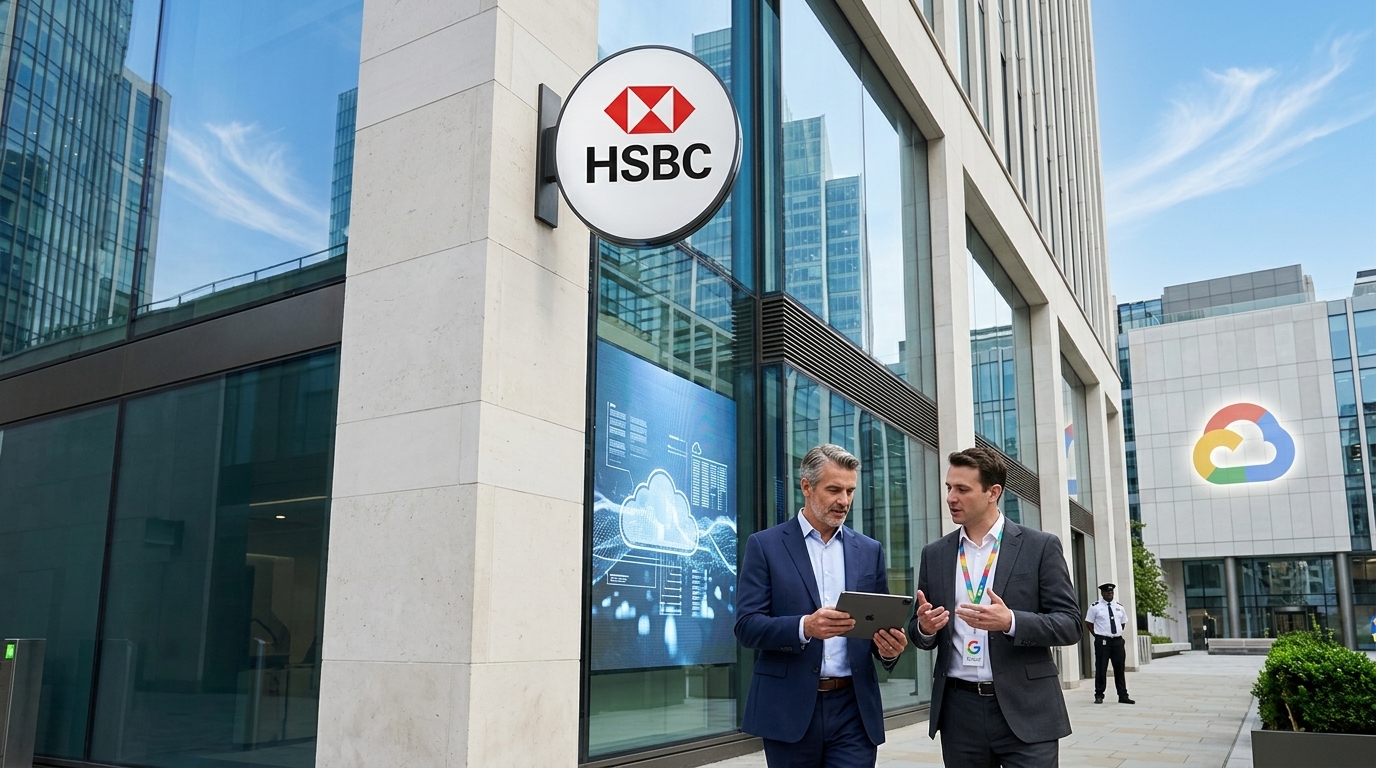
In an era where digital dominance in the financial sector is no longer judged by the size of balance sheets but by the speed of algorithms, HSBC and Google Cloud have forged a landmark agreement. With a budget exceeding $100 million, the two giants are committing to embedding Generative AI at the heart of global banking operations, aiming to develop more than 200 new applications over the next two years.
This move is not merely a technological upgrade but a fundamental rethink of the banking model. As we navigate through 2026, the 'experimental' phase of AI has given way to full-scale operational deployment. HSBC, an organization with a presence in dozens of markets, seeks to leverage Google’s infrastructure to solve some of the industry’s most intractable problems: from combating sophisticated financial crime to personalizing customer experiences in real-time.
The 200-Application Goal: Where Innovation Will Focus
HSBC’s 'AI-first' strategy focuses on three central pillars: operational efficiency, security, and customer experience. The commitment to 200 applications is ambitious, yet it reflects the need for speed in a competitive landscape where neobanks and tech giants threaten traditional market shares.
- Fighting Fraud and Money Laundering: Using Google’s machine learning models, the bank aims to reduce 'false positives' in transactions while identifying suspicious patterns that human analysis would fail to detect.
- Hyper-personalized Banking: Generative AI will allow HSBC to offer wealth management advice and loans tailored to each customer’s unique financial profile, analyzing data in seconds.
- Code Optimization and Internal Processes: A significant portion of the investment involves supporting the bank’s thousands of developers through Google’s AI tools, accelerating the development cycle of new products.
Utilizing Google Cloud’s Vertex AI platform and Gemini models provides HSBC with the necessary computational power and flexibility to train models on its own vast data reserves, while adhering to the strict security standards required by the industry.
The Challenge of Compliance and Ethics
Despite the excitement, this alliance moves through a minefield of regulatory rules. With the full implementation of the AI Act in the European Union and similar frameworks in the US and Asia, HSBC must ensure its algorithms are transparent and free from bias. The bank has stated that 'Responsible AI' is the cornerstone of the agreement.
"Artificial intelligence is no longer an option, but the fundamental prerequisite for survival in the modern financial ecosystem. Our partnership with Google Cloud allows us to scale innovation securely," say sources close to HSBC management.
The challenge lies in the balance between automation and human oversight. In areas such as loan approvals, the 'black box' logic of algorithms can lead to legal and ethical deadlocks. HSBC is investing heavily in staff training so that employees can interpret and audit the decisions suggested by AI.
Economic Footprint and the Cloud Battle
The $100+ million deal is also a major victory for Google Cloud in its battle against Amazon Web Services (AWS) and Microsoft Azure. The financial sector is considered the 'holy grail' of cloud services due to massive data volumes and the need for zero tolerance for errors.
For HSBC, this investment is expected to bear fruit through reduced operating costs. Automating back-office processes and more effective risk management can save billions over time, improving the bank’s cost-to-income ratio. In a world where interest rates remain volatile, operational efficiency through technology is the only sustainable advantage.
In conclusion, the HSBC and Google Cloud partnership marks the end of the era of 'pilot programs.' The banking of the future will be predictive, invisible, and deeply integrated into daily life, with AI acting as the invisible orchestrator of the global economy.





