

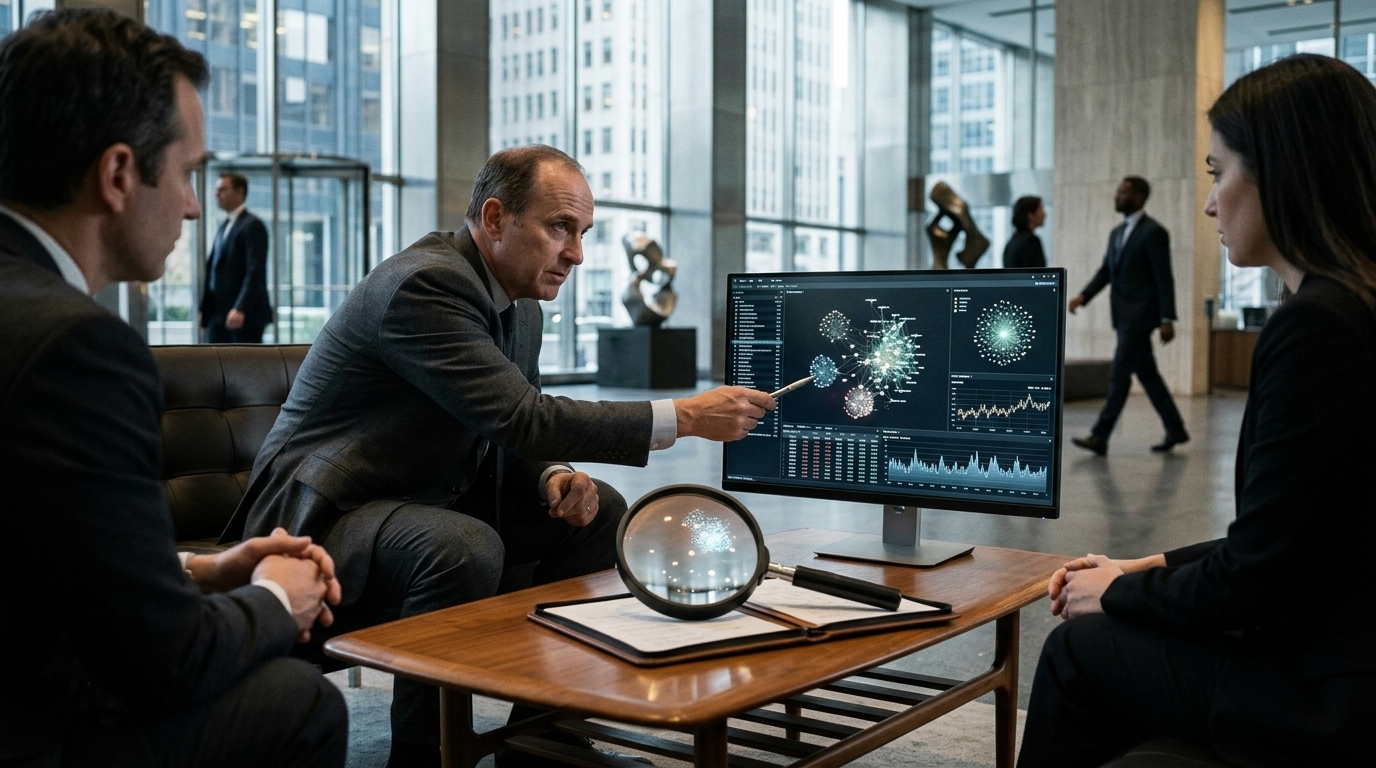
In the glass towers of Manhattan, where billion-dollar decisions are made in fractions of a second, artificial intelligence is no longer a futuristic promise but a vital survival tool. While OpenAI and Google battle for dominance in the mass market, Anthropic—the company founded by former OpenAI executives with a focus on safety—is following a different, more targeted path. Its goal is to become the "invisible engine" powering Wall Street, offering an AI model that is not only powerful but "constitutionally" committed to accuracy and ethics.
Safety as a Competitive Advantage
For major investment banks and hedge funds, the greatest fear is not a lack of innovation, but a lack of control. The "hallucinations" of large language models—their tendency to confidently invent facts—pose a prohibitive risk for an industry built on data precision. Anthropic has invested heavily in what it calls "Constitutional AI." This is a training method where the model is guided by a specific set of rules and principles, rather than relying solely on human feedback, which can be subjective or flawed.
This approach has captured the attention of giants like Bridgewater Associates and Goldman Sachs. In the financial world, an AI's ability to admit ignorance or highlight ambiguous points in a report is more valuable than a quick but inaccurate answer. Anthropic positions itself as the "adult in the room," providing an environment where compliance and risk management are baked into the code.
Managing the Ocean of Data: The Context Window
One of the strongest weapons in Anthropic's arsenal is Claude's massive context window. While other models struggle to process entire books, Claude 3.5 Sonnet can "read" and analyze thousands of pages of documents simultaneously. For a Wall Street analyst, this means they can feed the model ten different annual reports (10-Ks), hundreds of pages of Federal Reserve minutes, and dozens of analyst reports, asking for a combined risk analysis.
- Automating balance sheet analysis by identifying discrepancies over a decade.
- Synthesizing macroeconomic data to predict trends in commodity markets.
- Rapidly processing legal texts and contracts to identify hidden clauses.
This capability transforms Claude from a simple chatbot into a virtual "Junior Analyst" who never tires and can process volumes of information that would take a team of humans weeks to complete. This speed, combined with Claude 3.5 Sonnet's ability to understand complex charts and financial diagrams, makes it the ideal tool for the front office.
Strategic Alliances and Enterprise Penetration
Anthropic's strategy is based not only on technology but also on powerful alliances. Multi-billion dollar investments from Amazon and Google provided more than just capital; they provided access to cloud infrastructure (AWS and Google Cloud) already certified for use by financial institutions. Integrating Claude into Amazon Bedrock allows banks to use the model within their own secure environment, without their data being used to train Anthropic's central model—a critical detail for maintaining privacy.
"Wall Street isn't looking for the smartest AI; it's looking for the most reliable. Anthropic understood this before anyone else," says a New York investment bank executive.
The recent launch of the Claude Enterprise tier is the final move in its push into large corporations. With increased usage limits, advanced administrative tools, and security guarantees, Anthropic offers a comprehensive solution aimed directly at the Chief Information Officers (CIOs) of major banks, bypassing the noise of consumer applications.
Competition and the Future of Work
Despite its strong position, Anthropic faces stiff competition. OpenAI, backed by Microsoft, already has deep roots in the corporate world, while Google is integrating Gemini across its entire Workspace ecosystem. However, Anthropic's specialization in "safe" AI gives it an edge in the highly regulated financial sector. The remaining question is how this automation will affect jobs. If a Claude can do the work of ten first-year analysts, the structure of Wall Street is set to change radically, shifting value from data collection to critical thinking and high-level decision-making.
In conclusion, Anthropic isn't just trying to build a better chatbot. It's trying to build the operating system of the modern economy. If it succeeds in convincing Wall Street that Claude is its most trusted partner, then Silicon Valley will have achieved the most significant "acquisition" in the history of capitalism: the automation of money management itself.





