

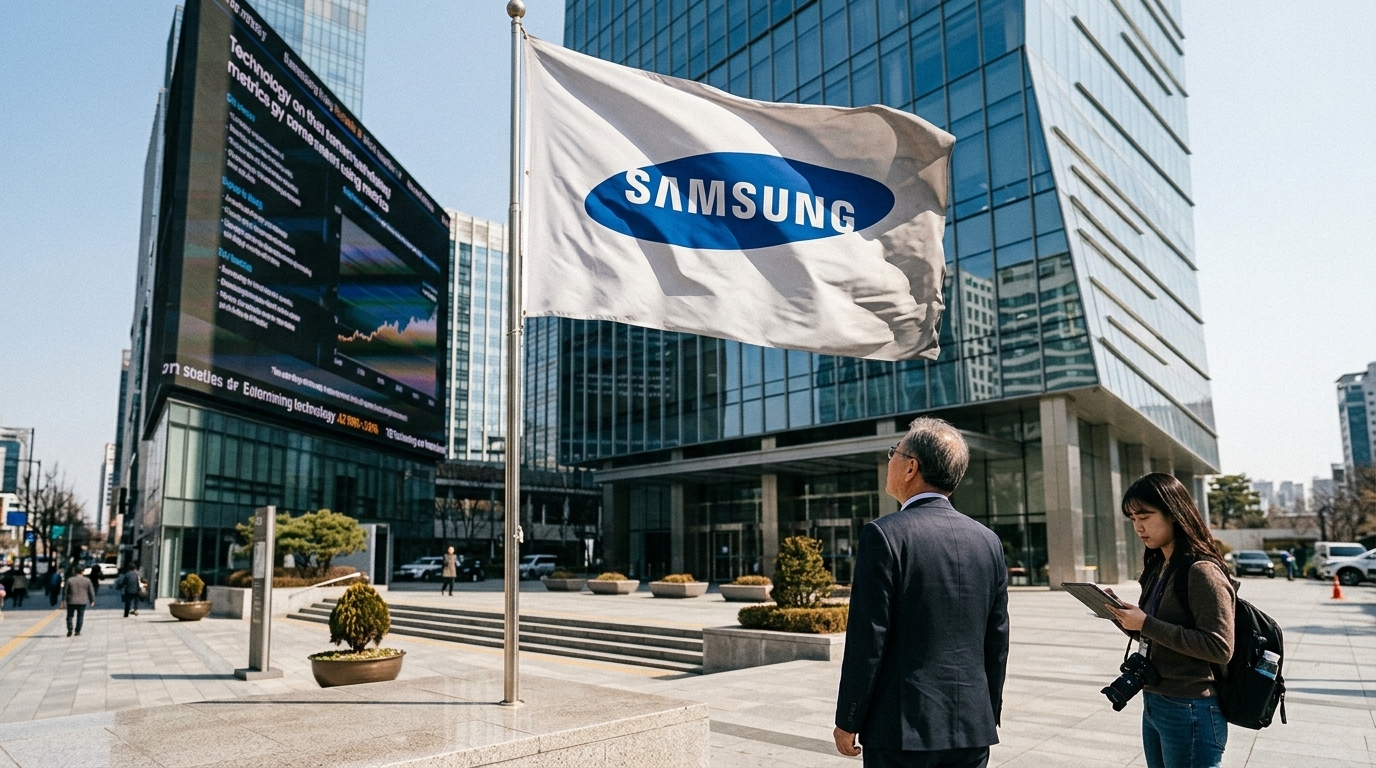
The history of Samsung Electronics has always been a narrative of adaptability. From its early days manufacturing black-and-white televisions to its dominance in the smartphone market, the Korean giant has consistently demonstrated an uncanny ability to ride the waves of technological evolution. However, its recent ascent toward the prestigious $1 trillion market capitalization milestone is not driven by its foldable phones or its ubiquitous OLED screens. Instead, it is fueled by something far more invisible yet utterly critical: High Bandwidth Memory (HBM).
As we navigate through 2026, artificial intelligence is no longer a mere promise; it is the primary engine of the global economy. Generative AI systems demand astronomical amounts of computational power. While Nvidia holds the reins with its high-performance GPUs, these processors are effectively bottlenecks without the specialized memory capable of feeding them data at the speed of light. This is where Samsung stepped in, overcoming a period of intense skepticism to win the high-stakes bet on next-generation semiconductors.
The War for HBM Supremacy
For a significant period, Samsung found itself in the uncharacteristic position of an underdog, trailing behind its domestic rival, SK Hynix, in the HBM3 technology race. SK Hynix had successfully secured an exclusive supplier role for Nvidia, leaving Samsung to grapple with yield issues and thermal management challenges in its early prototypes. However, a strategic counter-offensive launched in late 2024, which culminated this year, has fundamentally shifted the balance of power. Samsung funneled billions into the development of HBM3E and HBM4, while completely overhauling its Device Solutions (DS) division.
The successful qualification of its chips by Nvidia served as the ultimate green light for global investors. The market finally realized that Samsung is not just a consumer electronics brand; it is the essential 'arms dealer' in the AI arms race. The company’s unique ability to mass-produce these complex components at a scale that no other firm can match provided the necessary catalyst for its stock to reach record-breaking heights. The narrative has shifted from 'can they catch up?' to 'how far can they lead?'.
Geopolitics and the Korean 'Silicon Shield'
Samsung's meteoric rise is more than a corporate success story; it is a geopolitical landmark. In a world where the United States and China are locked in a structural conflict over semiconductor sovereignty, South Korea has emerged as an indispensable third pole. The Seoul government, recognizing Samsung's role as a linchpin of national security, has provided aggressive tax incentives and infrastructure support, fostering the creation of a massive semiconductor 'Mega Cluster'.
This 'Silicon Shield' protects not only the Korean economy but also the stability of the global supply chain. Analysts point out that Samsung’s entry into the $1 trillion club reflects a broader migration of value from software back to hardware. Without Samsung’s physical infrastructure, the large language models (LLMs) developed by the likes of Google and Microsoft would remain theoretical constructs. Samsung has effectively made itself 'too big to fail' in the age of artificial intelligence, positioning its hardware as the foundational layer of modern civilization.
Challenges and the Future of the Digital Empire
Despite this triumph, the path forward is not devoid of obstacles. Competition from Taiwan’s TSMC remains fierce, particularly in the foundry business where Samsung is still fighting to close the gap in advanced node manufacturing (2nm and beyond). Furthermore, the internal structure of the Chaebol—Korea’s family-run conglomerates—faces increasing pressure for transparency and modernization of corporate governance to satisfy a more globalized shareholder base.
Nevertheless, Samsung appears to have forged a new identity. By integrating AI across its entire ecosystem—from smart home appliances to enterprise-grade servers—it is achieving a level of vertical integration that few competitors can replicate. Joining the $1 trillion club is the reward for a long-term strategy that prioritized fundamental innovation over quarterly fluctuations. In the new digital cosmos, Samsung is no longer a fast follower; it is the architect of the infrastructure that will define the rest of the decade.





