

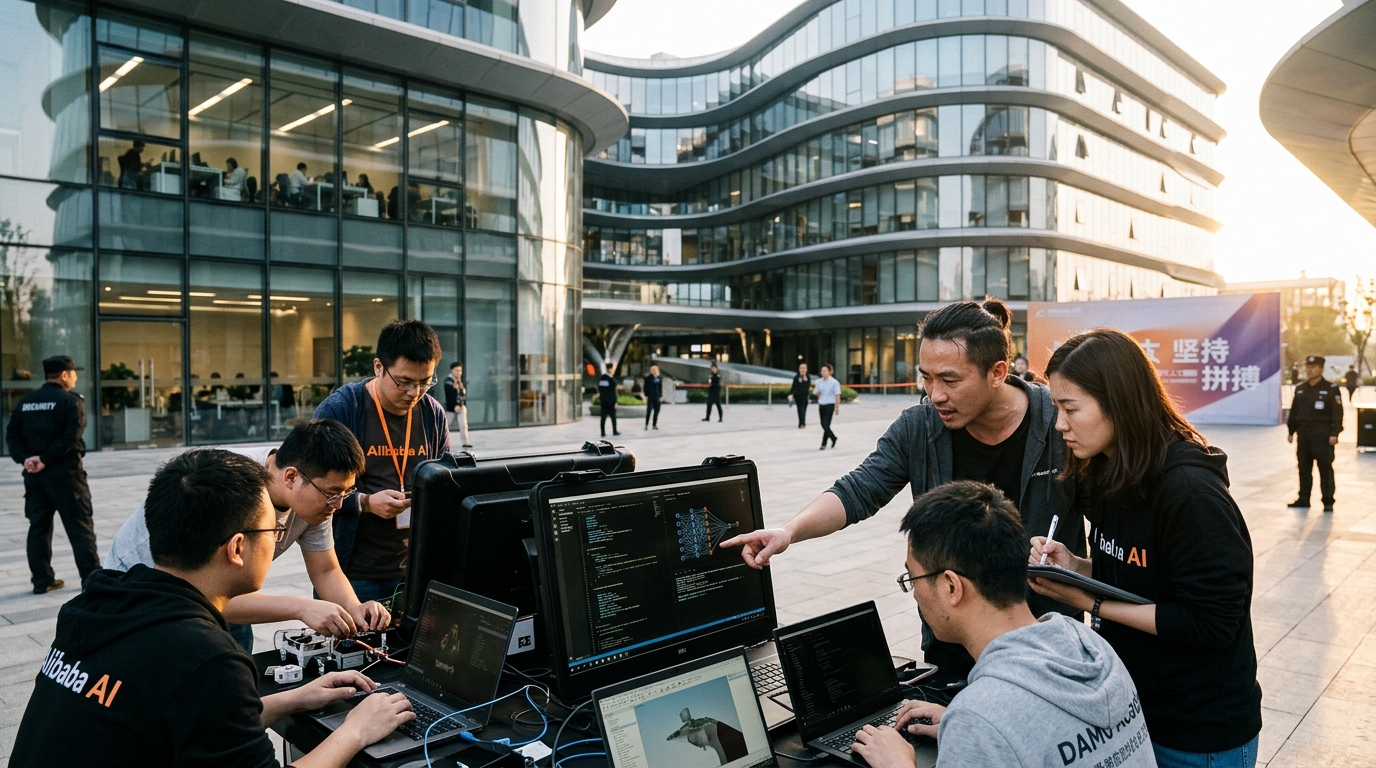
In the heart of Hangzhou, where China’s digital pulse beats strongest, Alibaba is not merely fighting a battle for e-commerce dominance; it is engaged in an existential struggle for AI supremacy. Recent reports surrounding the company’s team-building activities reveal a calculated return to the hardcore values of endurance and absolute dedication, echoing the early, hungry days of Jack Ma. At a time when Silicon Valley is debating work-life balance and the ethics of efficiency, Alibaba is sending a clear signal: winning the AI era requires an "iron" discipline.
The Resurrection of 'Wolf Culture'
Team-building at Alibaba has never been just about social outings or trust falls. It involves exercises designed to test the limits of employees' mental and physical fortitude. This approach, often referred to as "wolf culture" (lang xing), aims to forge teams capable of functioning under extreme duress. For the new leadership under CEO Eddie Wu and Chairman Joe Tsai, reigniting this spirit is seen as essential to fending off aggressive rivals like ByteDance and Pinduoduo.
Employees are increasingly being asked to adopt a "wartime" footing. This means the development of the Qwen (Tongyi Qianwen) models is not just a technical project, but a mission requiring hours that often surpass the infamous "996" schedule. Management believes that technological superiority is not derived solely from algorithms, but from a team’s ability to outlast and outwork its competitors in the grueling cycle of model training and deployment.
AI as an Existential Mandate
Alibaba’s pivot to an "AI-first" strategy is a total commitment. After scrapping the spinoff of its Cloud division, the company has doubled down on investing billions into cloud infrastructure and the training of Large Language Models (LLMs). The Qwen models have already shown impressive benchmarks, rivaling GPT-4 in specific tasks, particularly in Chinese linguistics and coding capabilities.
- Integrating generative AI into Taobao and Tmall to revolutionize personalized retail.
- Developing AI-driven logistics solutions through Cainiao to optimize global shipping.
- Providing a robust AI-as-a-Service (AIaaS) platform to thousands of enterprises via Alibaba Cloud.
However, the challenge is two-fold. Internally, the domestic competition in China is fierce, with Tencent and Baidu moving at breakneck speeds. Externally, US export restrictions on advanced semiconductors (such as NVIDIA’s H100s) have forced Alibaba to become exceptionally creative. Here, "endurance" translates to the engineering prowess required to optimize software to perform at peak levels on less capable hardware.
The Human Toll of the AI Race
Despite the leadership's fervor, the return to grueling work rhythms is not without friction. China’s younger workforce, the Gen Z cohort, is showing a growing reluctance to sacrifice their well-being for corporate glory. The "lying flat" (tang ping) movement serves as a quiet but potent protest against the relentless pressure of the tech sector. Alibaba now faces the delicate task of balancing the need for speed with the looming threat of mass burnout.
"Technology is the tool, but will is the driving force. At Alibaba, we aren't just building code; we are building character," a sentiment reportedly shared during a recent internal seminar.
In conclusion, Alibaba’s culture serves as a microcosm of the broader Chinese tech landscape. In a world being rapidly reshaped by artificial intelligence, the company is betting that the traditional Chinese virtues of patience, resilience, and hard work will be its "secret weapon" against Western innovation. Whether this approach is sustainable in the long run remains to be seen, but for now, Alibaba is in a state of full mobilization, proving that in the race for the future, there is no room for the faint-hearted.





