

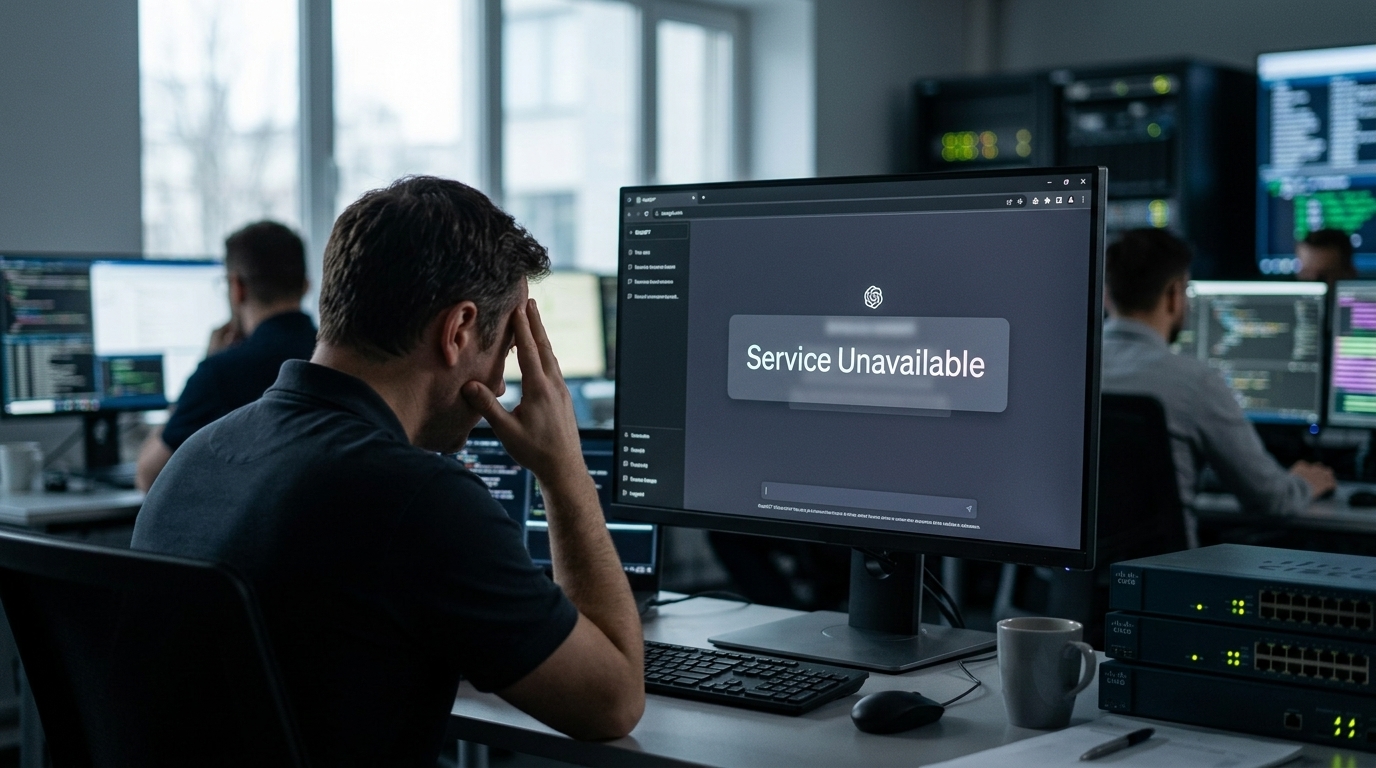
The scene was familiar yet jarring for the global digital community: a blank screen, an "Internal Server Error" message, and the sudden inability of millions to complete their daily tasks. The recent collapse of OpenAI’s services, affecting both ChatGPT and the critical API powering thousands of third-party applications, was more than just a technical glitch. It was a stark reminder of the fragile nature of the modern knowledge economy, which has now invested billions into an infrastructure controlled by a handful of players.
Chronicle of a Digital Silence
It began in the early hours when reports on DownDetector started to spike geometrically. Users from San Francisco to Athens and Tokyo reported that ChatGPT was unresponsive or displaying incomplete conversation histories. OpenAI moved quickly to acknowledge the issue, updating its status page with "investigating widespread outages." However, recovery was not instantaneous. For several hours, the "oracle" of the digital age remained in a coma.
The outage was not limited to the free tier. ChatGPT Plus subscribers, who pay for priority access, also found themselves locked out, sparking a wave of backlash on social media. But the most significant blow was dealt to businesses. In today's market, OpenAI's API is used for customer service, code generation, and real-time data analysis. When the API goes down, entire production chains freeze.
The Dangerous Reliance on the Cloud
This collapse brings to the fore a deeper issue: cloud dependency and the concentration of power. Unlike traditional software installed locally, Generative AI requires massive computing power that only giants like Microsoft (via Azure) can provide to OpenAI. This creates a "single point of failure" that can have systemic consequences.
- Business Continuity: Many startups are built entirely on top of GPT-4. A few hours of downtime can mean thousands of dollars in lost revenue and credibility.
- Psychological Dependency: Users have become accustomed to using AI as an "external brain." Its absence causes a form of digital paralysis.
- The Security Gap: During the investigation into the causes, the question always lingers: Is this a code bug or a well-organized DDoS cyberattack?
Competition and Alternatives
While OpenAI struggled with its servers, competitors were not idle. Anthropic’s Claude and Google’s Gemini saw a sharp increase in traffic as "ChatGPT refugees" sought alternatives. This phenomenon highlights the need for a multi-model approach. Experts warn that companies should not rely on a single AI provider, much like they wouldn't rely on a single power or telecom provider.
"This outage is the wake-up call we needed. Artificial intelligence is now a public utility, and it must be treated as such, with safeguards and redundancy plans," says a market analyst.
The Road Ahead for OpenAI
OpenAI eventually managed to restore services, attributing the problem to "infrastructure instability." However, trust has been shaken. As the company moves toward GPT-5 and further integration into our daily lives, stability becomes as important as intelligence. The lesson from the global blackout is clear: the smarter our tools become, the more vulnerable we are when they go silent. The need for local AI models (on-device AI) that operate without an internet connection seems more urgent than ever.





