

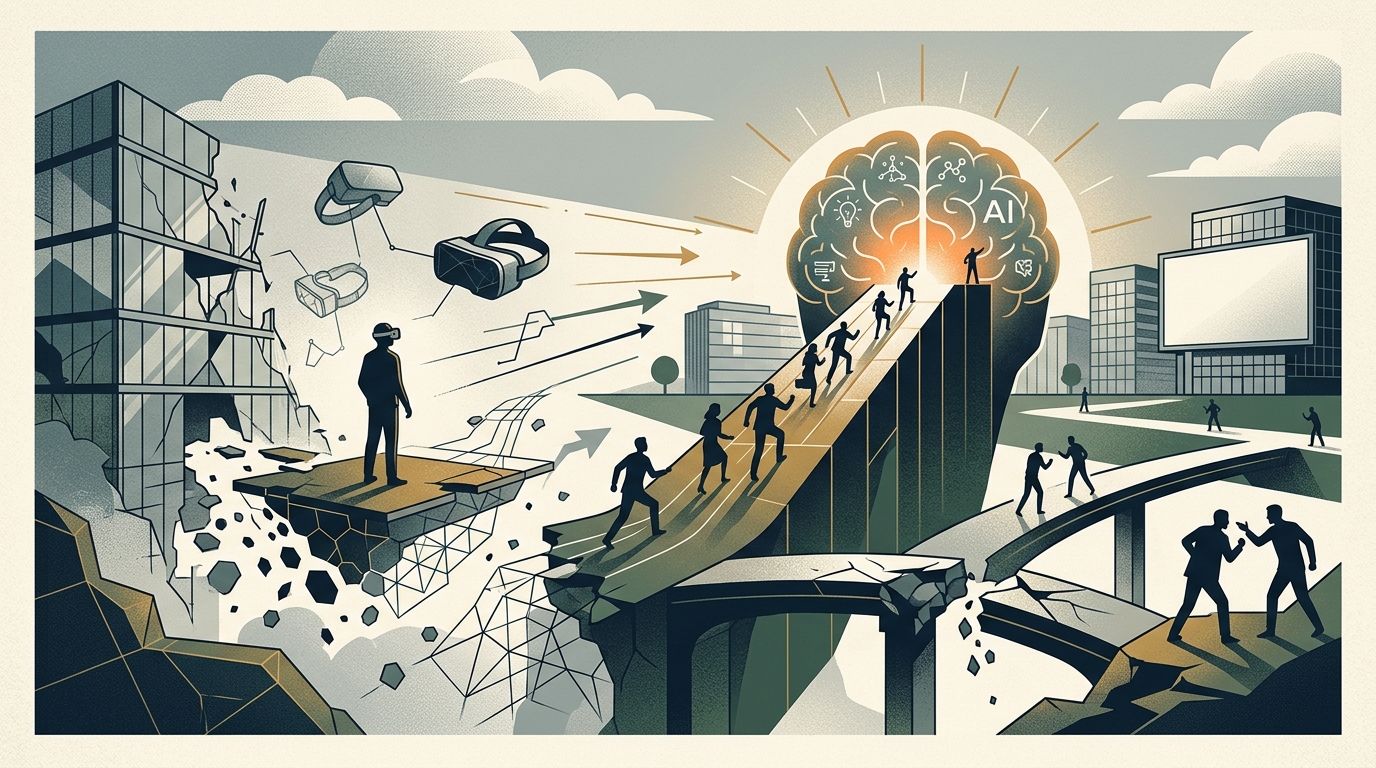
When Mark Zuckerberg rebranded Facebook to Meta in 2021, the promise was clear: the creation of a digital universe, the Metaverse, where humanity would live, work, and interact. Three years later, that vision seems to have been put on the back burner, as the tech giant pivots its entire focus—and capital—toward Artificial General Intelligence (AGI) or "Superintelligence." However, this abrupt shift is not without cost. Beyond the billions of dollars being spent on NVIDIA processors, Meta faces a deep internal morale crisis and growing dissatisfaction among its top talent.
The 'Year of Efficiency' and Unhealed Wounds
Zuckerberg's 2023 strategy, which he dubbed the "Year of Efficiency," led to more than 20,000 layoffs. While markets reacted positively, sending the company's stock soaring, the internal climate remains somber. According to recent reports and employee testimonies, the company culture has sustained irreparable damage. Meta, once famous for its freedom and perks for its engineers, has transformed into an environment of intense stress and uncertainty.
Employees involved in developing AI systems, such as the Llama model, report grueling hours and a sense of "discontinuity." The sudden movement of resources from Reality Labs (the Metaverse division) to the GenAI department has created internal friction. Many data scientists and engineers feel that management is sacrificing long-term research for the sake of immediate competitiveness against OpenAI and Google.
The Race for Superintelligence
Zuckerberg no longer hides his intentions. His goal is for Meta to become the leader in developing AGI—an intelligence that will exceed human capabilities in every field. To achieve this, the company has begun an unprecedented accumulation of computing power. By the end of 2024, Meta is expected to own approximately 350,000 NVIDIA H100 graphics cards, an investment totaling nearly $10 billion.
"Our strategy is to build the most advanced infrastructure in the world for AI," Zuckerberg recently stated, emphasizing that the open release of Llama is the "key" for Meta to dominate the new ecosystem.
However, Meta's "open source" approach is drawing mixed reactions. While it allows thousands of developers to use its models, many analysts wonder if this is a sustainable business move or a desperate attempt to undermine the closed-model dominance of Microsoft and OpenAI. Furthermore, the internal pressure to release Llama 4 is immense, with teams working under "war-footing" conditions.
The Cost of Ambition and the Risks
Meta is not only facing internal issues. The pivot to AI requires massive amounts of energy and water for cooling data centers, sparking backlash from environmental organizations. Meanwhile, regulatory pressure from the European Union and the US regarding AI safety and data privacy remains at its peak. Meta has already suspended training its models with EU user data due to strict GDPR rules, putting it at a disadvantage compared to US markets.
- Financial Risk: Capital expenditure (CapEx) is rising rapidly, with no clear revenue model from AI yet.
- Talent Drain: Meta is losing top AI researchers who prefer smaller, more agile startups like Anthropic or Mistral.
- Identity Crisis: The company is trying to be a social media firm, a hardware manufacturer (Quest), and an AI leader simultaneously, fragmenting its focus.
Conclusion: A Bet on Survival
Meta is at a critical crossroads. Mark Zuckerberg seems to believe that the only path for his company's survival is AI dominance. However, if he fails to restore employee trust and present a product that yields real profits beyond advertising, Meta risks becoming a giant with "feet of clay." The transition from the Metaverse to Superintelligence is not just a change of code, but a test of an entire organization's resilience against the most disruptive technology of our time.





