

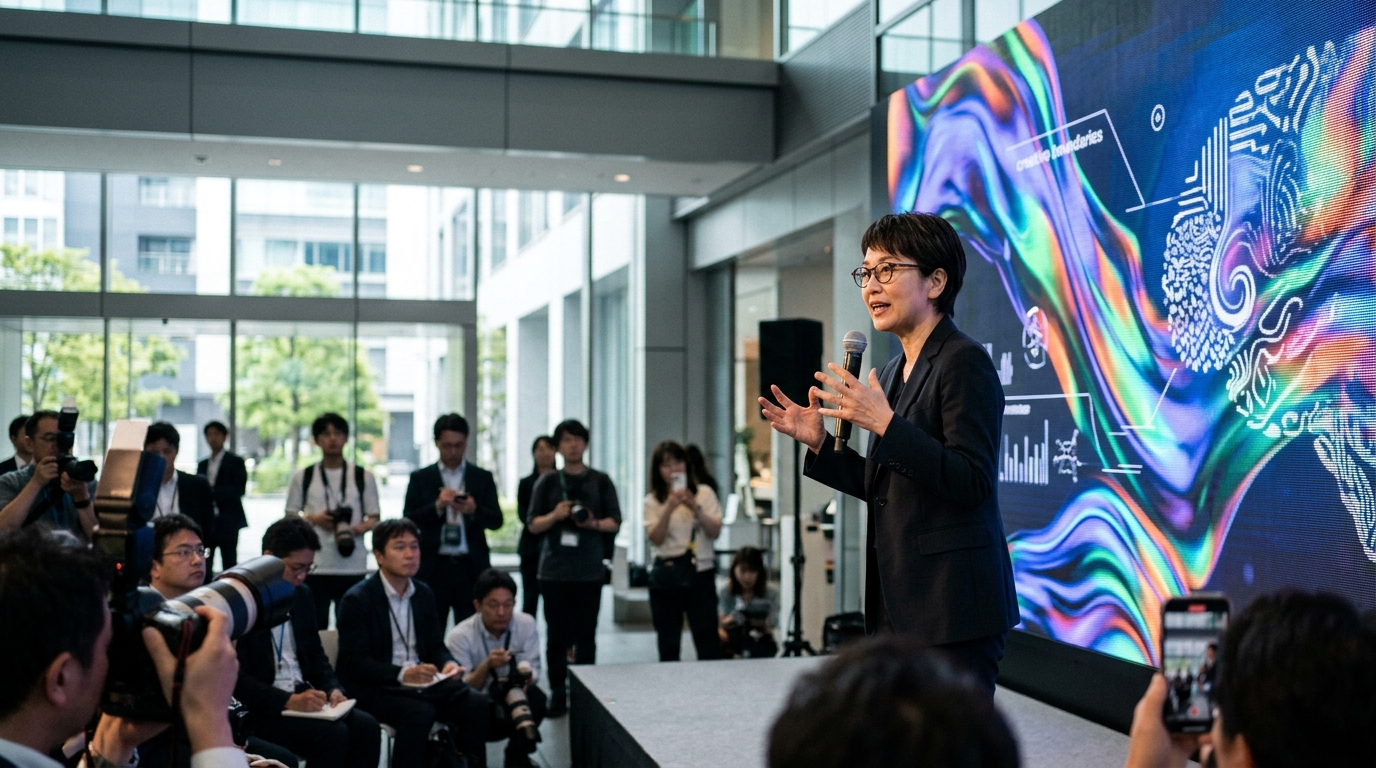
In an era where the advertising industry often views Artificial Intelligence (AI) as a mere tool for cost-cutting and the automation of mediocrity, Japanese giant Dentsu has decided to take a different, far more audacious path. The company’s recent "Maximalist AI Manifesto" is not just an internal directive; it is a clarion call for the reclamation of imagination. Dentsu is challenging its 72,000 employees worldwide to use generative AI (GenAI) not to make things simpler, but to make them more complex, richer, and more profoundly human through the lens of excess.
The Philosophy of Maximalism in the Digital Age
Maximalism in the arts has always been a reaction against minimalism—a celebration of "more is more." Within the context of Dentsu, this approach translates into using AI to create visual and narrative experiences that would be impossible to conceive or execute using traditional methods. The agency argues that if AI is used solely for speed, the result is a homogenized aesthetic devoid of soul. Conversely, by urging its creatives to "push the limits," Dentsu aims for a new form of "technological baroque," where detail and complexity become the new benchmarks of quality.
This strategic move comes at a critical juncture for the group. With competition from rivals like WPP and Publicis intensifying in the tech space, Dentsu chooses to differentiate itself through "creative intensity." The manifesto emphasizes that AI must function as an "imagination multiplier." This means the creator is no longer just an executor of ideas but a curator of the infinite, capable of synthesizing thousands of variations of a concept until they find the one that evokes the deepest emotional resonance.
Global Mobilization and Creative Pressure
Implementing this manifesto was no easy feat. Dentsu’s creative teams in London, Tokyo, New York, and São Paulo were called upon to abandon safe harbors. According to internal sources, the process involved intensive workshops where AI was used to deconstruct and rebuild classic campaigns with hyper-detailed specifications. The result was a series of projects that defy market logic: images with thousands of hidden elements, videos that morph based on the viewer's emotions, and soundscapes created by translating complex data sets into music.
- Aesthetic Redefinition: Moving from clean lines to visual abundance.
- Staff Training: Over 10,000 hours of training in specialized GenAI tools.
- Ethics and Intellectual Property: Developing closed AI models to protect client rights and data.
However, this "pushing of limits" brings its own set of challenges. Creative burnout is a real risk when technology allows for endless production. Dentsu’s rebuttal is that fatigue stems from repetition, not invention. The manifesto encourages creators to view AI as a partner that handles the "heavy lifting" of execution, leaving the human in the role of the strategic visionary and ultimate arbiter of taste.
Market Reaction and the Future of Advertising
The industry is watching this approach with keen interest. While many clients demand cost reductions through AI, Dentsu is offering them something they didn’t know they needed: a return to grandeur. In a world saturated with "fast content," the maximalist approach offers a sense of permanence and artistic value. Analysts believe that if Dentsu can prove that "rich" AI delivers a better Return on Investment (ROI) than "cheap" AI, it will have fundamentally changed the rules of the game for the entire sector.
"We don’t want AI to make our work easier. We want AI to make our work impossible without it," a Dentsu Creative executive noted during the manifesto's launch.
In conclusion, Dentsu’s Maximalist Manifesto is a bold statement on the future of human labor. In a world fearing displacement by machines, Dentsu proposes a symbiosis where the machine provides the raw material of the infinite, and the human directs it toward the sublime. It is a gamble that, if successful, will prove that technology is not the enemy of art, but its most powerful ally in the pursuit of the unthinkable.





