

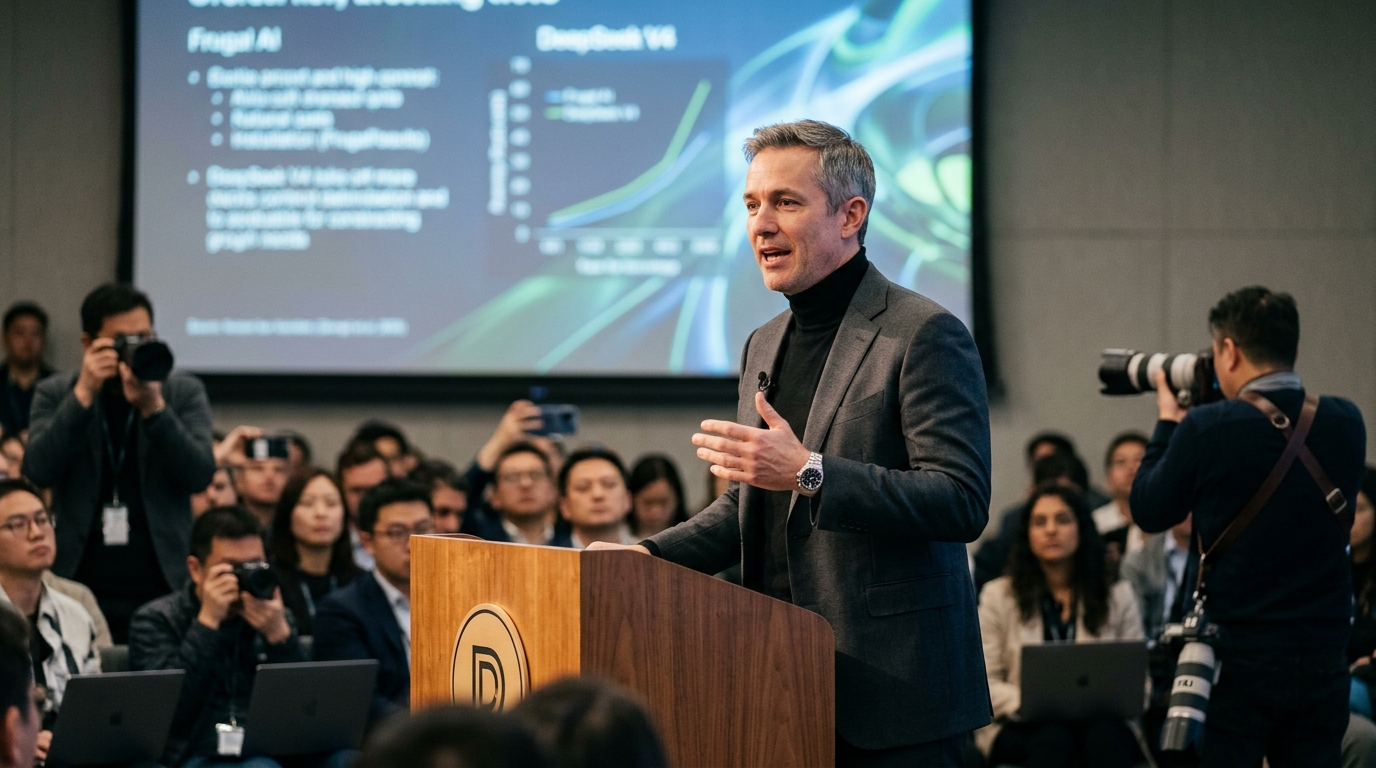
The global AI chessboard is experiencing a seismic shift. While the dominance of OpenAI and Google was taken for granted for years, the emergence of the Chinese lab DeepSeek has upended the balance of power. Anticipation for DeepSeek V4, the company's next flagship model, has reached a fever pitch as developers and enterprises desperately seek alternatives that combine high performance with low operational costs. This development is not merely a technical upgrade; it is an ideological challenge to the 'brute force compute' model championed by Silicon Valley.
The DeepSeek Strategy: Efficiency Over Excess
DeepSeek did not become a household name in tech through billion-dollar ad campaigns, but through its innovative Mixture of Experts (MoE) architecture. The upcoming V4 promises to further refine this approach, allowing the model to activate only the necessary segments of its parameters for any given query. This translates to dramatically lower inference costs and faster response times. In a market where API costs remain the primary barrier to widespread AI adoption for SMEs, DeepSeek offers a 'democratic' alternative.
Demand for V4 stems primarily from its prowess in coding and mathematics—areas where its predecessors, such as DeepSeek-R1, have already outperformed GPT-4o in specific benchmarks. The Chinese firm has managed to achieve these results using a fraction of the resources employed by its American rivals, proving that algorithmic ingenuity can sometimes outweigh the sheer volume of data and silicon.
Smart Signage and Mobility Infrastructure
Parallel to the advancements in large language models, significant news has emerged regarding funding in the 'mobility signage' sector. The integration of artificial intelligence into urban infrastructure is no longer a science fiction scenario. New investments are flowing into systems that utilize AI to direct traffic in real-time, communicate with autonomous vehicles, and provide dynamic information to pedestrians.
- Dynamic traffic management to reduce carbon emissions.
- Signage systems that adapt to weather conditions and emergency events.
- Integration of city-wide sensor data to predict and mitigate congestion.
This funding highlights a pivot toward 'Applied AI.' While LLMs capture the headlines, the technology affecting the daily lives of citizens is found on the streets and in the infrastructure. The ability of cities to 'speak' to their inhabitants through intelligent displays and sensors represents the next frontier of urban development.
The Geopolitical Dimension and Constraints
One cannot ignore the political context in which DeepSeek operates. Despite stringent US export controls on advanced chips (such as Nvidia’s H100s) to China, Chinese engineers have proven remarkably resourceful. The success of DeepSeek V4 will serve as a loud signal that technological barriers may delay, but do not halt, innovation. On the contrary, they often force players to become more efficient with fewer resources.
"DeepSeek isn't competing with OpenAI on who has the largest warehouse of chips, but on who can think more cleverly with the chips they already have," market analysts note.
In conclusion, today marks a new phase in the history of AI. On one hand, we see the maturation of models becoming more accessible and efficient (DeepSeek), and on the other, the expansion of intelligence into the physical world through mobility infrastructure. The question is no longer whether AI will change the world, but who will hold the keys to this change and at what price.





