

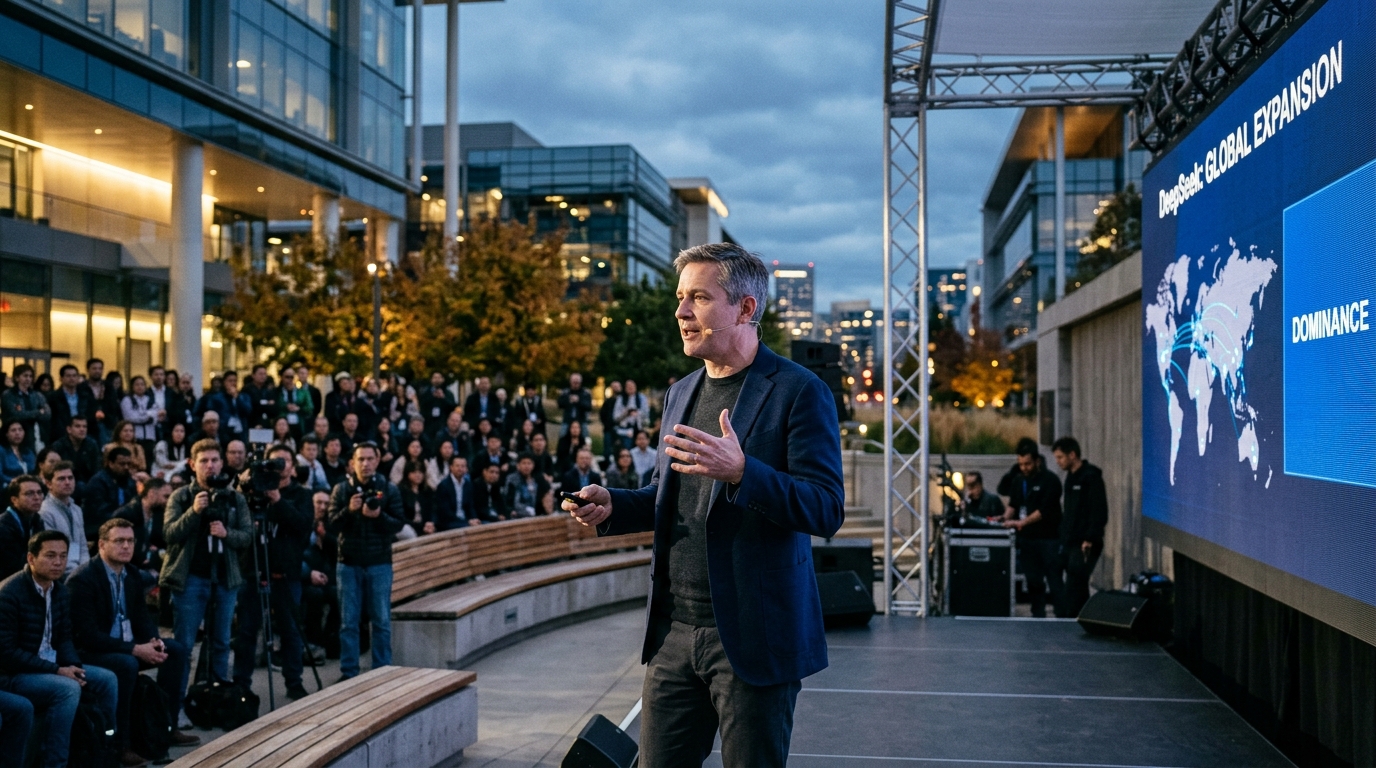
In the rapidly shifting landscape of global Artificial Intelligence, few names have generated as much strategic tremor as DeepSeek. The news that the company plans to at least double its staff across all departments is not merely a corporate announcement; it is a profound declaration of intent from the heart of Beijing to Silicon Valley. At a time when American giants like OpenAI and Google are grappling with the staggering costs of infrastructure and energy, DeepSeek is championing a model that fuses Chinese work ethic with unprecedented algorithmic ingenuity.
The Strategy of Efficient Scaling
DeepSeek is not your typical high-growth startup. Emerging from the foundations of High-Flyer Quant, an algorithm-driven hedge fund, DeepSeek brought a mindset of financial precision and optimization to the development of Large Language Models (LLMs). While the rest of the industry was blindly following "scaling laws"—simply throwing more GPUs and data at the problem—DeepSeek proved that a Mixture-of-Experts (MoE) architecture could deliver GPT-4 level performance at a fraction of the training cost.
The decision to double their workforce suggests that the phase of pure, lean research is evolving into one of commercial implementation and global scaling. The company now requires more than just elite researchers; it needs infrastructure engineers, AI safety specialists, and business strategists capable of pivoting open-source success into sustainable enterprise products. This move comes at a critical juncture as China seeks to eliminate its dependence on foreign technology, positioning DeepSeek as the vanguard of national AI sovereignty.
Geopolitics and the Talent War
DeepSeek’s expansion is unfolding under the long shadow of US-led semiconductor export controls. Despite restricted access to Nvidia’s top-tier chips, DeepSeek has consistently stunned the international community by training high-performance models on less powerful hardware. Doubling their staff is a clear rebuttal to the logic of sanctions: human ingenuity can bridge the hardware gap.
However, the challenge is two-fold. Firstly, securing top-tier talent within China is fiercely competitive, with behemoths like ByteDance and Alibaba offering astronomical compensation packages. Secondly, DeepSeek must maintain its agility as it scales. Tech history is littered with companies that lost their innovative edge the moment they became bureaucratic. For DeepSeek, the gamble is to remain a "lab" at its core while operating as a titan in practice.
The Future: From Code to Commodity
What does this expansion mean for the end-user and the global market? Primarily, we can expect an acceleration in the release of models that are more accessible and efficient. DeepSeek has already earned the trust of the developer community with DeepSeek-Coder, and bolstering its workforce will allow for a deeper foray into multimodal models—those capable of processing image, sound, and video with the same fluidity as text.
"DeepSeek isn't just competing in AI; they are redefining what is possible within constraints," note market analysts in Beijing.
In conclusion, DeepSeek's move to double its headcount marks a milestone for 2026. It is not just an increase in size, but the maturation of a player aiming to become a central pillar of the global AI ecosystem. If OpenAI represents the symbol of American resource abundance, DeepSeek is becoming the symbol of Chinese strategic efficiency. The bipolar world of AI is no longer a forecast; it is a reality.





