

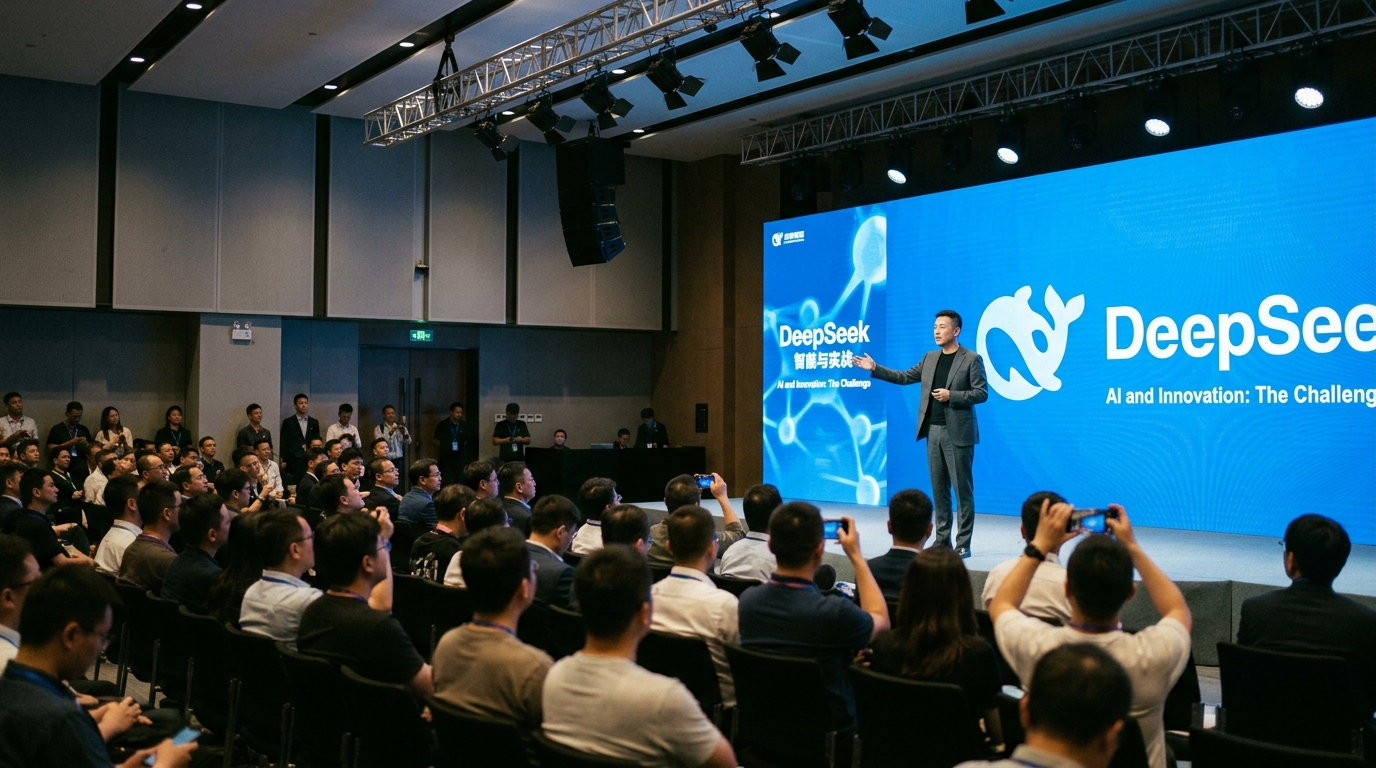
The news reverberated through the corridors of Silicon Valley like a sudden thunderclap: DeepSeek, the Chinese AI research firm that managed to humble American tech giants with its sheer efficiency, is reportedly in talks for its first official funding round. The valuation? A staggering $45 billion. This development is not merely a business headline; it marks a tectonic shift in the geopolitical technology map, proving that the dominance of OpenAI and Google is no longer a foregone conclusion.
The Rise from Obscurity to the Global Stage
Until a few months ago, DeepSeek was a name known only to niche circles of AI researchers. As a subsidiary of High-Flyer Quant, a Chinese hedge fund that utilizes high-frequency algorithms for trading, DeepSeek had the luxury of working in relative silence. The unveiling of its DeepSeek-V3 and DeepSeek-R1 models changed everything. These models weren't just "good for a Chinese firm"; they were on par with, and in some benchmarks superior to, OpenAI’s GPT-4o and Anthropic’s Claude in reasoning and coding tasks.
The most striking element, however, was the cost. While OpenAI spent hundreds of millions of dollars training its flagship models, DeepSeek claimed to achieve similar results at a fraction of the price, using fewer resources and a more sophisticated architecture. This "algorithmic efficiency" is precisely what has ignited investor interest, leading to the current $45 billion valuation talks. It challenges the prevailing Western philosophy that more compute and more money are the only paths to AGI.
The Architecture of Success and the Open-Weights Strategy
DeepSeek’s strategy rests on two pillars: technical innovation and the open-weights model. By employing a Mixture-of-Experts (MoE) architecture, the company has managed to build models that activate only a subset of their parameters during processing, drastically reducing computational requirements. In a world where Nvidia GPUs are the most expensive and scarcest commodity, DeepSeek’s ability to do more with less is nothing short of revolutionary.
Furthermore, the decision to release its models as "open weights" allowed developers worldwide to adopt them rapidly. This created an ecosystem that serves as both free marketing and quality control for the company. However, this approach raises questions about the sustainability of its business model. If the core technology is free, where will the revenue come from to justify a $45 billion price tag? The answer likely lies in enterprise solutions, specialized API services, and the integration into China's massive industrial and financial sectors.
Geopolitical Chess and US Sanctions
The rise of DeepSeek comes during a period of intense friction between the US and China. Export restrictions on advanced chips (like Nvidia’s H100) were designed to slow Chinese AI progress. DeepSeek has demonstrated that intellectual ingenuity can, to some extent, bypass material barriers. The company’s success deals a blow to the narrative of American technological exceptionalism and forces Washington to re-evaluate its containment strategy.
"DeepSeek is not just an AI company; it is proof that algorithmic design can trump brute-force compute power," market analysts suggest.
Nevertheless, the path forward is fraught with obstacles. DeepSeek must balance the Chinese Communist Party's requirements for censorship and content control with its own need for global credibility. Recent instances where the models' responses on politically sensitive topics were altered or restricted serve as a reminder that no Chinese entity operates in a vacuum. The tension between "open" technology and a "closed" political system will be DeepSeek's greatest challenge.
Economic Implications and the Road Ahead
A $45 billion valuation places DeepSeek in the same league as giants like SpaceX or ByteDance in their formative years. If the funding round closes, it will be one of the largest in AI history. Investors are betting that DeepSeek will become the "OpenAI of the East," providing a robust alternative to the Western monopoly. For the global market, this translates to fiercer competition, lower prices for AI services, and an acceleration of innovation that seemed unimaginable just a year ago. The AI race is no longer a sprint by a single nation; it is a global marathon with a new, formidable frontrunner.





