

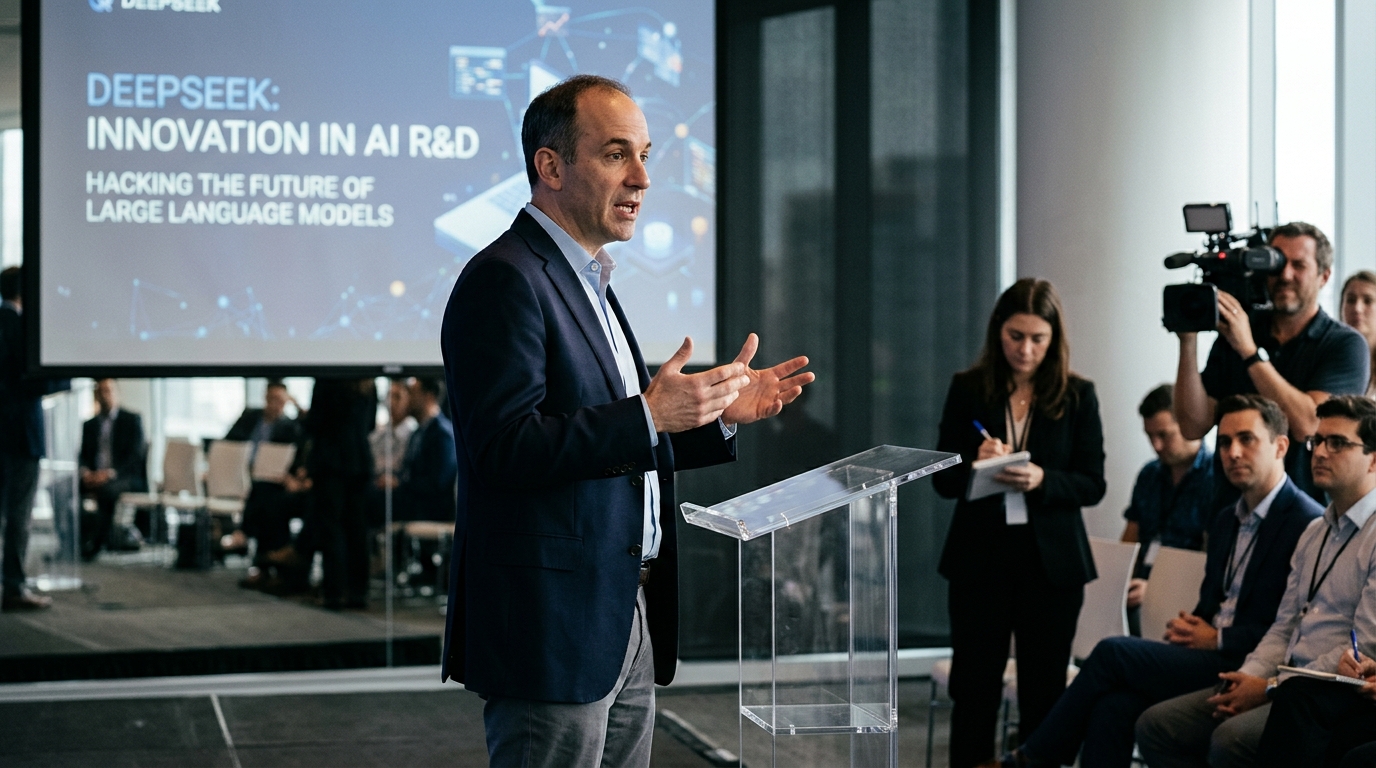
Until recently, the AI narrative was written almost exclusively in English, headquartered in San Francisco, and funded by Wall Street titans. The emergence of DeepSeek, a Chinese AI lab backed by High-Flyer Capital Management, has upended this dynamic in a matter of weeks. This is not just a new series of models; it is a fundamental challenge to how technological power is constructed in the 21st century. DeepSeek is not merely participating in the competition; it is running three distinct races simultaneously: the race for efficiency, the race for reasoning, and the geopolitical race for technological sovereignty.
The Collapse of the Massive Cost Myth
For years, Silicon Valley convinced us that "scaling" is the only path to intelligence. The recipe was simple: more data, more Nvidia chips, and billions of dollars in electricity. DeepSeek shattered this myth with the DeepSeek-V3 model. While OpenAI and Google spend hundreds of millions training their flagship models, DeepSeek achieved comparable or superior results for just $6 million.
Their strategy relied on an architecture called Multi-head Latent Attention (MLA) and a sophisticated version of Mixture-of-Experts (MoE). Instead of activating the entire network for every query, DeepSeek's models use only the necessary segments, dramatically reducing computational costs. This "lean" approach is not just a technical detail; it is an existential threat to the business models of American firms that rely on massive capital expenditure as a "moat" to protect against competition.
DeepSeek-R1: Democratizing Reasoning
The second race concerns the ability of AI to "think" before responding. With the release of DeepSeek-R1, the company entered directly into the territory previously monopolized by OpenAI's o1 model. R1 uses reinforcement learning techniques to solve complex problems in mathematics, programming, and logic, displaying its internal "chain of thought."
What is impressive is not just the performance, but DeepSeek's decision to release the model as open weights. This allows developers worldwide to run a GPT-4o or o1-level model on their own servers without being dependent on the APIs of American giants. This move redistributes power from closed platforms to the global developer community, causing a tremor in the revenue projections for Big Tech.
The Geopolitical Chessboard and the Failure of Sanctions
The third and perhaps most critical race is geopolitical. DeepSeek's success occurred despite strict US sanctions banning the export of Nvidia's most advanced chips (such as the H100 and B200) to China. DeepSeek proved that algorithmic ingenuity can compensate for hardware scarcity. By using older technology (H800) with highly optimized software, Chinese engineers managed to bypass Washington's hurdles.
This creates a headache for US policymakers. If the goal of the sanctions was to keep China behind in the AI race, DeepSeek shows that the result was the opposite: it forced the Chinese industry to become more inventive and efficient. DeepSeek is no longer just a company; it is the symbol of Chinese technological resilience and proof that Silicon Valley's monopoly on innovation has come to an end.
Conclusion: A New Era for AI
DeepSeek has changed the rules of the game. The race for artificial intelligence is no longer just about who has the most money, but about who can think more cleverly about the architecture of intelligence itself. As markets react and governments rethink their strategies, one thing is certain: the road to Artificial General Intelligence (AGI) no longer runs solely through California.





