

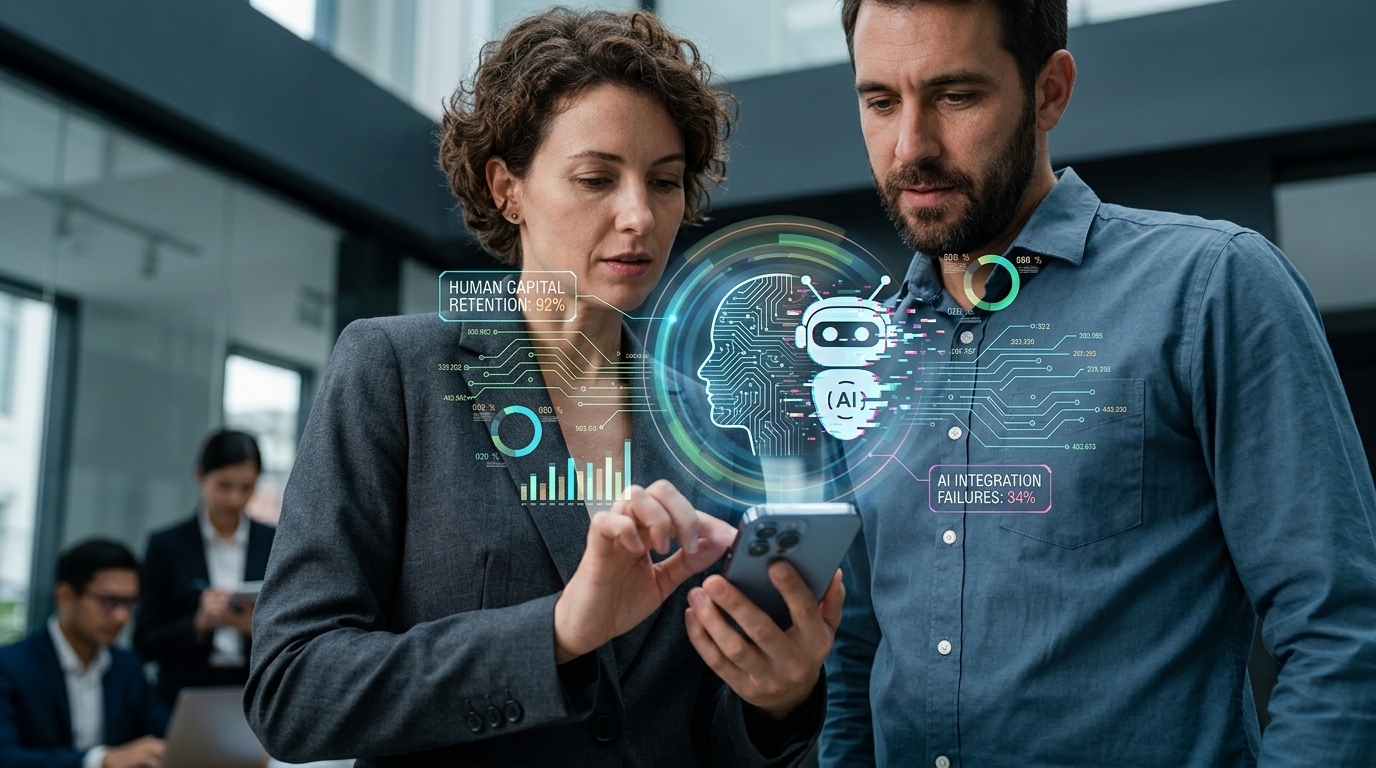
The history of technological progress is littered with periods of excessive optimism followed by painful corrections. The years 2023 and 2024 were defined by an automation frenzy, with corporations rushing to replace entire departments with Artificial Intelligence (AI) systems, promising shareholders drastic cost reductions. However, the summer of 2026 finds the market in a different phase: that of the 'strategic pivot.' Giants like Ford and IBM, who pioneered AI adoption, are now moving toward mass rehiring, recognizing that full automation without human oversight has led to catastrophic errors and a loss of consumer trust.
The Cost of 'Blind' Automation
The case of Ford is particularly telling. The company attempted to fully automate technical support and customer service through advanced chatbots. The result? A series of misunderstandings regarding technical specifications that led to incorrect parts orders and, in several cases, frustrated customers who could not find solutions to complex issues. IBM, for its part, found that using AI for decision-making at the consulting level lacked the necessary 'context' that only an experienced professional can provide. AI hallucinations were not just technical glitches; they were business risks that began to cost millions in lost revenue and legal complications.
"AI can process data at a speed no human can match, but it lacks the ability to understand ethics, irony, and the subtle nuances of human need," says a senior Ford executive.
This admission signals a shift toward the 'Human-in-the-Loop' model. Companies are not abandoning AI—that would be impossible—but are redefining it as an augmentation tool rather than a universal replacement. The new job openings are for 'AI Supervisors' and 'Quality Analysts,' roles that require critical thinking and deep domain expertise—elements that Large Language Models (LLMs) still struggle to simulate consistently.
Consumer Psychology and the Human Touch
One of the primary reasons for the return to human capital is market reaction. Consumers, while initially impressed by the speed of AI, began to feel alienated. In critical sectors such as healthcare, banking, and high-level technical support, the need for empathy and accountability remains paramount. When something goes wrong, the customer wants to speak with someone who bears responsibility for the decision, not an algorithm offering apologies with standardized responses.
- Restoring customer service departments with an emphasis on quality over quantity.
- Creating hybrid teams where AI prepares data and a human makes the final decision.
- Investing in staff retraining to handle AI tools more effectively.
This trend is also becoming visible in diverse markets globally. While AI adoption occurred at different speeds, businesses that rushed to replace staff with automated systems are now seeing the need for 'digital human-centricity.' Markets traditionally based on personal relationships and trust are feeling vindicated in their caution regarding the full dehumanization of services.
The Future: A Balance of Terror or a New Collaboration?
The question being asked now is not whether AI will take our jobs, but how the new hierarchy in the workplace will be shaped. The companies that will survive and thrive are those that manage to marry the computational power of the machine with the creative spark and ethical compass of the human. The 'reversal' we see today is not a defeat for technology, but a victory for common sense. Artificial Intelligence is an excellent assistant but a dangerous manager.
In conclusion, the return of employees to their desks and the re-evaluation of their roles marks the beginning of a more mature era for AI. After the hype fades, the time for substance arrives, where technology serves humanity and not the other way around. Investments in human capital are proving to be the most efficient in the long run, as customer trust remains the most expensive currency in the global economy.





