

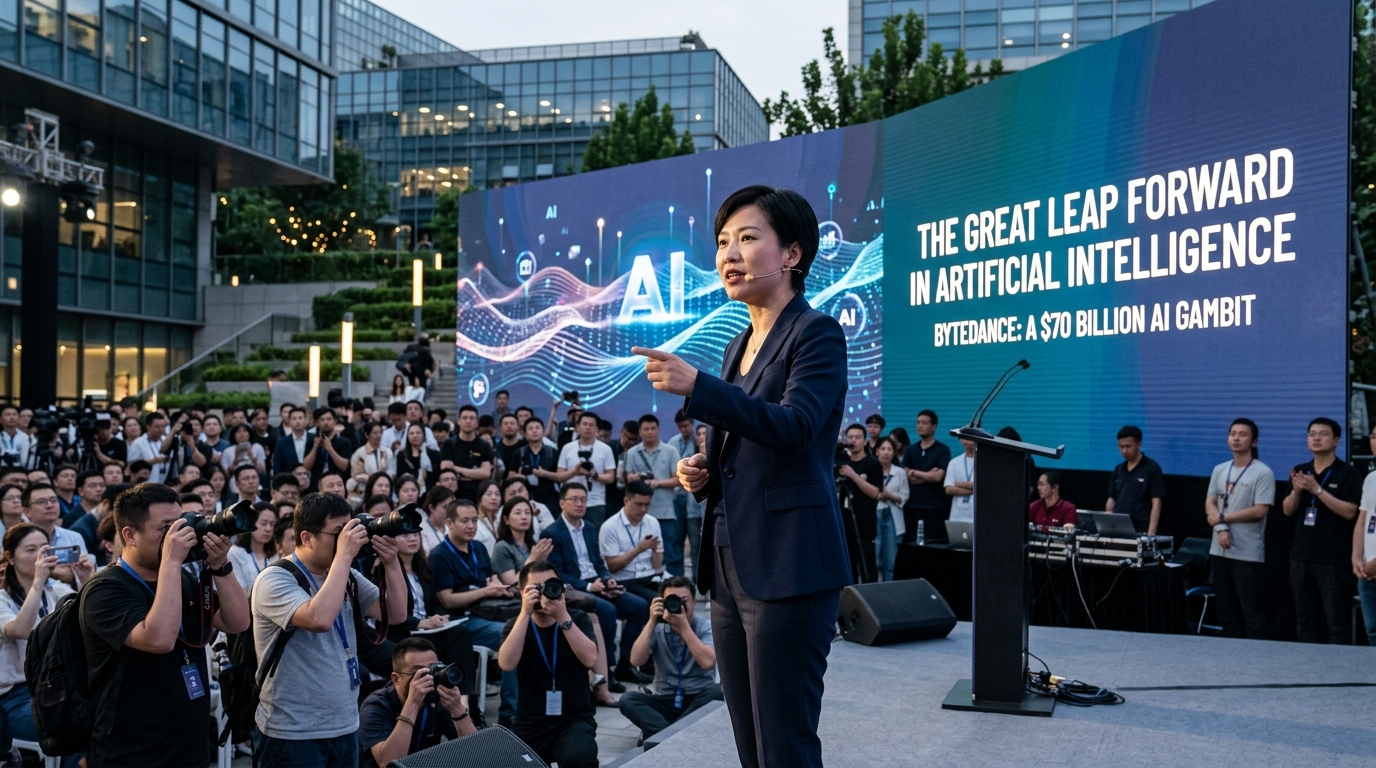
In a move set to redefine the global technological landscape, ByteDance, the Chinese behemoth behind TikTok, is reportedly preparing a gargantuan investment program of up to $70 billion for Artificial Intelligence (AI) infrastructure. The news, first reported by Bloomberg, highlights the company's unwavering resolve to remain at the forefront of the global AI race, despite intensifying Western scrutiny and export restrictions.
This investment is far more than a mere upgrade to TikTok’s algorithms, which are already widely considered the most sophisticated in the world. It represents a fundamental strategic pivot toward Generative AI, aiming to build an ecosystem capable of directly challenging the likes of OpenAI, Microsoft, and Google. At the heart of this push is the desperate need for massive computing power and specialized semiconductors, at a time when access to Nvidia’s top-tier hardware is increasingly restricted for Chinese firms due to US sanctions.
The 'Hyper-Investment' Strategy and the Doubao Model
ByteDance has already demonstrated its prowess within the domestic Chinese market. Its large language model (LLM), Doubao, has successfully eclipsed Baidu’s Ernie Bot in popularity, offering lower costs for developers and a highly intuitive user interface. The decision to weigh a $70 billion capex (capital expenditure) signal suggests ByteDance intends to scale this success globally, constructing the physical and virtual foundations necessary to train even more complex and multi-modal models.
This scale of spending places ByteDance in the same elite bracket as Mark Zuckerberg’s Meta, which has also announced astronomical figures for GPU procurement. However, for ByteDance, the stakes are twofold: it must maintain its dominance over user attention while simultaneously insulating itself against a potential US ban. AI investment serves as a form of 'technological insurance'—if the social media front is compromised, the underlying AI infrastructure remains a formidable asset.
- Procurement of tens of thousands of Nvidia H20 chips (optimized for the Chinese market).
- Development of proprietary ASICs to reduce reliance on Western supply chains.
- Expansion of state-of-the-art data centers in Southeast Asia and Europe.
- Recruitment of top-tier global AI researchers with highly competitive compensation packages.
The Semiconductor Hurdle and Geopolitical Headwinds
The primary obstacle to ByteDance’s ambitions remains Washington. Export controls on advanced AI chips have forced the company to seek creative workarounds. While Nvidia has developed lower-performance versions for the Chinese market, ByteDance recognizes that long-term survival requires autonomy. Market sources suggest a significant portion of the $70 billion will be channeled into designing custom silicon in collaboration with partners like Broadcom.
"ByteDance isn't just buying chips; they are purchasing their future as a primary architect of the next industrial revolution," noted a senior industry analyst based in Beijing.
This aggressive posturing is also causing ripples among domestic rivals like Tencent and Alibaba, who see ByteDance moving with significantly more speed and aggression. The company’s ability to generate massive cash flow from TikTok and Douyin provides the liquidity needed to fund this bold venture without relying on external capital markets, which have become increasingly wary of Chinese tech.
The Road Ahead: AI as the New Social Fabric
What does this mean for the average user? ByteDance envisions a future where AI is not just a search tool but the very fabric of digital creation. From automated high-quality video generation to personalized education and AI-driven e-commerce, the $70 billion investment will manifest in applications that make today’s TikTok look like a rudimentary tool. The goal is to create an immersive, AI-generated experience that anticipates user needs before they are even articulated.
In conclusion, ByteDance is proving that the battle for AI supremacy is not just about code, but about capital and hardware. In a technologically bifurcated world, the Chinese giant is doubling down on sheer scale, betting that technological superiority will eventually override political friction. Whether this $70 billion gamble pays off depends as much on the engineers in Beijing as it does on the regulators in Washington.





