

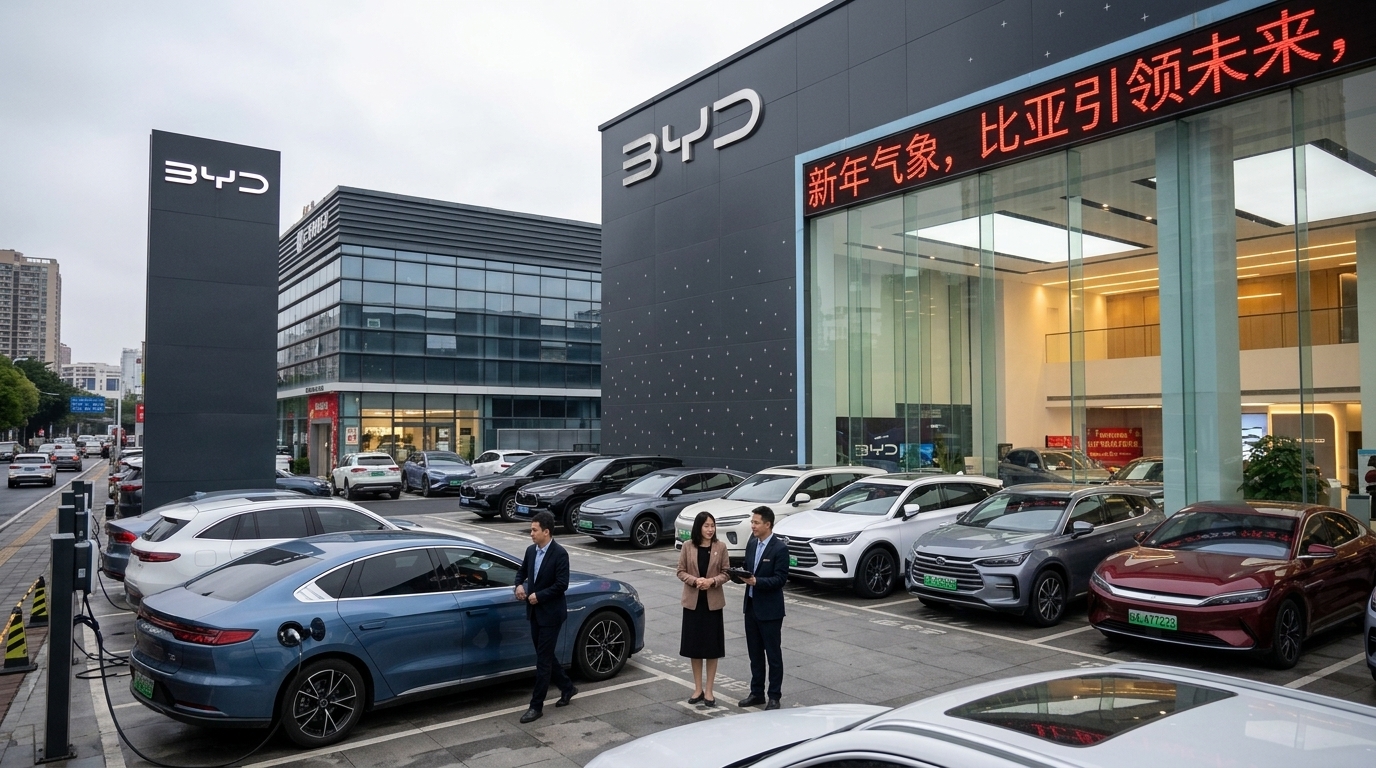
The global automotive stage is experiencing a tectonic shift that transcends mere commercial rivalry. The battle between BYD (Build Your Dreams) and Tesla is no longer just a clash of two companies, but a confrontation between two different economic models and industrial philosophies. As we move through 2026, Shenzhen-based BYD appears to have found the momentum necessary to permanently dethrone Elon Musk's company from the top of the pure electric vehicle (BEV) sales charts.
Vertical Integration as a Strategic Weapon
BYD's greatest advantage over Tesla and traditional European manufacturers is its unprecedented vertical integration. While Tesla relies on a vast network of suppliers for critical components, BYD manufactures almost everything in-house: from its 'Blade' batteries—considered among the safest in the world—to semiconductors and powertrain systems. This autonomy allows the Chinese giant to keep costs exceptionally low, offering vehicles that combine affordability with technological sophistication.
According to recent data, BYD delivered over 557,000 electric cars in the last quarter, a staggering increase that puts it within striking distance of Tesla's numbers. BYD's ability to scale production without being hindered by global supply chain disruptions is the key factor allowing it to dominate not only in China but also in the emerging markets of Southeast Asia and Latin America.
Geopolitics and the 'Wall' of Tariffs
BYD's rise has not gone unnoticed by Western governments. The European Union and the United States have adopted protectionist policies, imposing tariffs on Chinese EVs citing unfair state subsidies. However, BYD's strategy is proving more resilient than analysts anticipated. The company is investing billions in establishing factories on European and American soil—in Hungary, Turkey, and Mexico—to bypass trade barriers and gain 'local producer' status.
"BYD isn't just exporting cars; it's exporting an entire industrial ecosystem that Western powers are struggling to compete with in terms of speed and cost," notes a market analyst.
On the other hand, Tesla faces its own set of challenges. An aging model lineup (Model 3 and Model Y) and delays in introducing a truly affordable vehicle (the long-rumored 'Model 2') have created a market void that BYD is rushing to fill with a blitz of new releases, ranging from the budget-friendly Seagull to the ultra-luxury Yangwang brand.
The Software and Autonomous Driving Frontier
If BYD is winning on hardware, Tesla is still widely regarded as the leader in software. Tesla's Full Self-Driving (FSD) system remains the industry benchmark. However, BYD has launched a massive counter-offensive in the field of Artificial Intelligence. By hiring thousands of software engineers and partnering with giants like Nvidia, the Chinese automaker aims to close the autonomous driving gap within the next two years.
2026 is expected to be the year where AI determines a vehicle's success more than its horsepower. BYD is already integrating advanced driver assistance systems into its new models, offering an experience that approaches Western standards but at a fraction of the price. The battle for data and dominance on the roads of the future has only just begun.
Conclusion: A New World Order
BYD's imminent return to the top spot signals the end of American hegemony in the electric vehicle sector. While Tesla remains a powerhouse of innovation and a potent status symbol, BYD represents the democratization of electromobility. For the global consumer, this competition is beneficial, as it drives down prices and accelerates technological evolution. However, for the global economy, BYD's dominance serves as a reminder that the center of gravity for industrial power has definitively shifted to the East.





