

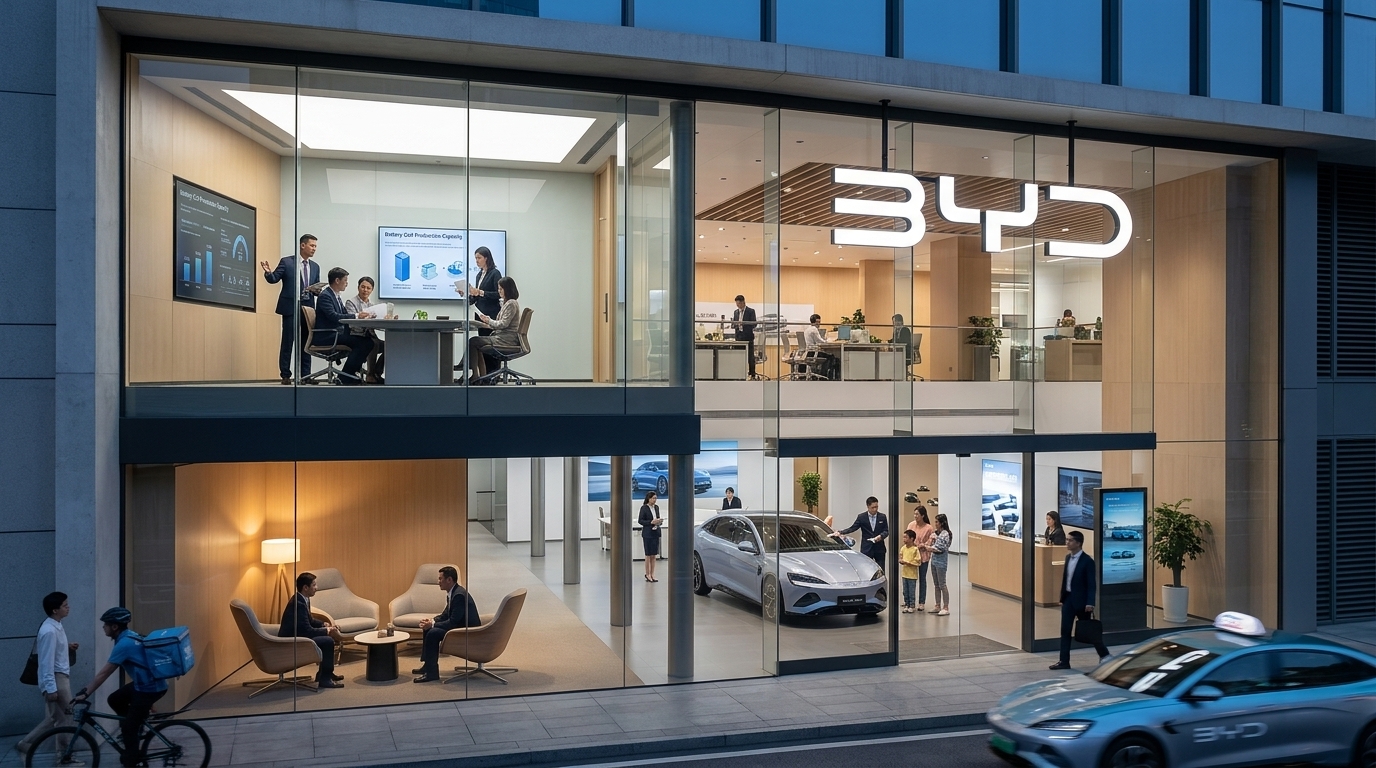
The global automotive industry is at a historic crossroads, and the direction is increasingly being dictated by Chinese innovation. Wang Chuanfu, the founder and chairman of BYD—the world’s leading electric vehicle (EV) manufacturer—recently issued a forecast that has sent shockwaves through the traditional automotive hubs of Detroit, Stuttgart, and Tokyo. He predicts that New Energy Vehicle (NEV) penetration in the Chinese market is set to reach a staggering 80% in the coming years. This isn't just corporate optimism; it is the data-driven reality of a market that is abandoning the internal combustion engine (ICE) at an unprecedented pace.
The Velocity of an Electric Revolution
For decades, China was the growth engine for Western automakers. Giants like Volkswagen and General Motors dominated the landscape through state-mandated joint ventures, capitalizing on a burgeoning middle class. However, the pivot to electrification has rewritten the rulebook. Today, China has transitioned from a technology adopter to a global trendsetter. NEV penetration (which includes both Battery Electric Vehicles and Plug-in Hybrids) has already crossed the 50% threshold in several major Chinese cities, relegating traditional gasoline cars to a shrinking minority.
Several factors are converging to make the 80% target achievable. First, China’s charging infrastructure is vastly superior to that of the West, reducing 'range anxiety' for the average consumer. Second, the technological edge in battery manufacturing—pioneered by BYD’s Blade Battery—allows for the production of vehicles that are both safer and more energy-dense. Third, the aggressive price war initiated by BYD in early 2024, under the mantra 'Electricity is cheaper than oil,' has made ICE vehicles economically uncompetitive for the mass market.
The Decline of Joint Ventures and the Rise of BYD
The joint venture model, once the primary vehicle for foreign entry into China, is reaching its expiration date. Foreign brands are witnessing their market shares evaporate as domestic players offer more tech-forward, affordable, and culturally resonant products. BYD’s success is rooted in its radical vertical integration. Unlike traditional OEMs that rely on a complex web of global suppliers, BYD manufactures nearly every component in-house: from semiconductors and batteries to electric motors and interior trim. This provides a massive cost advantage and allows the company to maintain margins even during brutal price wars.
- BYD overtook Tesla in total EV volume in late 2023, signaling a shift in global leadership.
- The introduction of the 'Seagull' model, priced under $10,000, has democratized EV ownership.
- Software-defined vehicle features and AI-driven autonomous driving are becoming the new competitive benchmarks.
Analysts suggest that if Wang’s 80% prediction holds true, legacy automakers will face an existential crisis in China. We are already seeing the fallout: Mitsubishi has ceased local production, while Volkswagen has been forced to invest billions into Chinese startup Xpeng to gain access to the software architecture and EV platforms it failed to develop internally.
Geopolitical Friction and the Road Ahead
China’s dominance in the EV sector is no longer just a business story; it is a geopolitical flashpoint. The European Union and the United States are responding with tariffs and trade barriers, fearing that an influx of low-cost Chinese EVs will decimate their domestic manufacturing sectors. However, Wang Chuanfu remains undeterred, arguing that protectionism cannot stifle genuine innovation. BYD is already executing a 'global-local' strategy, establishing manufacturing hubs in Hungary, Brazil, and Thailand to bypass trade restrictions and embed itself in local economies.
"The industry is undergoing a once-in-a-century transformation. This is not just about replacing an engine; it is about the total reimagining of mobility," Wang recently stated.
In conclusion, the 80% milestone in China will likely serve as the final chapter for fossil-fuel-powered passenger cars in East Asia. For the rest of the world, the question is no longer whether they will follow suit, but how quickly they can adapt before Chinese dominance becomes an irreversible reality. BYD is not just building dreams; it is building a new world order on wheels.





