

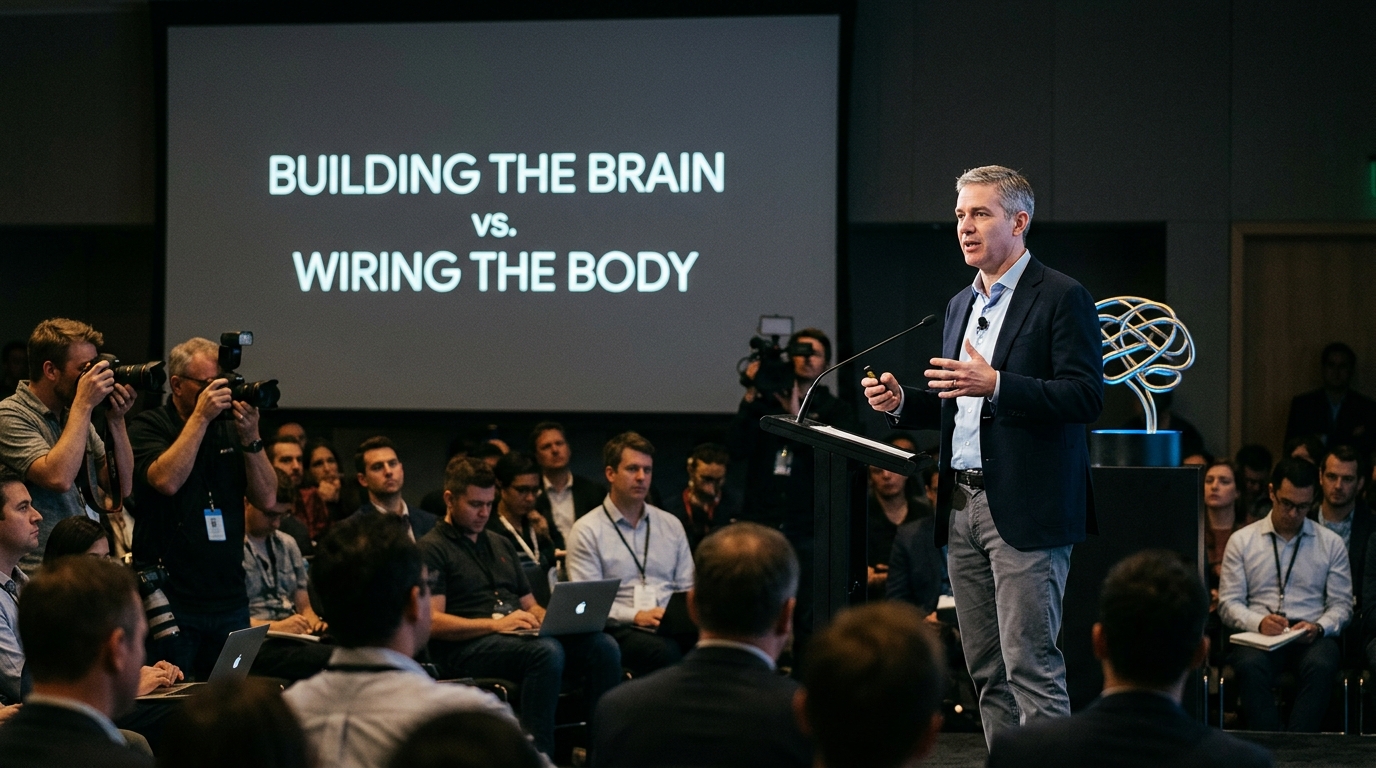
As we navigate the summer of 2026, the global business landscape has moved past the initial euphoria surrounding Generative AI. The era of experimentation and flashy demos has been replaced by a stark reality: possessing the 'brain' (the AI model) is the easy part. The hard part, and the one determining corporate survival today, is 'wiring the body'—integrating artificial intelligence into daily processes, data infrastructures, and corporate culture.
The Illusion of Ready-Made Intelligence
For years, business leaders believed that purchasing a license for an advanced Large Language Model (LLM) would magically solve productivity woes. As highlighted in a recent IMD analysis, this approach focuses exclusively on 'building the brain.' Tech giants have indeed created digital minds with astonishing reasoning capabilities. However, a brain without a nervous system and muscular structure remains trapped in a vat.
In the current market, we see this phenomenon play out repeatedly. Many companies rush to adopt AI solutions only to find that their data is fragmented across legacy systems, employees distrust system outputs, and decision-making processes remain bogged down by bureaucracy. 'Wiring' requires more than just code; it demands a radical overhaul of how the organization functions.
The Challenge of Organizational Wiring
What does 'wiring the body' mean in practice? It involves creating the necessary connections that allow information to flow seamlessly from the AI to the points of action. This includes three critical pillars:
- Data Governance: Without clean, accessible, and secure data, the AI 'brain' is fed noise. Wiring begins with the unification of data silos.
- System Interoperability: AI must be able to 'talk' to the ERP, CRM, and supply chain management tools. If AI suggests a solution that cannot be executed automatically, its value is drastically diminished.
- Human Integration: The most difficult wiring is that which connects humans to machines. Employee training is no longer just about 'how to use the tool,' but 'how to collaborate with a digital colleague.'
As IMD points out, failure in wiring leads to what we call 'AI Friction.' This is the state where technology, instead of accelerating, slows down the organization due to incompatibilities and internal resistance.
From Intelligence to Agency
2026 is the year of 'AI Agents.' Unlike the simple chatbots of the past, agents have the capacity to take action. They can close deals, reroute orders, or resolve complex technical issues without constant human supervision. However, for an agent to function, the 'wiring' must be flawless.
"The difference between a successful business and a failing one in the AI era won't be who has the best model, but who has the most flexible body to host it."
This realization is shifting the roles of the CEO and CTO. The CTO is no longer just a technology buyer but a 'systems architect' who must ensure every neuron of the enterprise is connected. Strategy now focuses less on 'what AI can do' and more on 'what we allow AI to do within our organization.'
Conclusion: A Return to Fundamentals
Paradoxically, the solution to this high-tech challenge lies in very traditional concepts: change management, clear strategy, and operational excellence. The companies that will triumph are those that treat AI not as a foreign object attached to the business, but as the new central nervous system requiring a holistic restructuring. Building the brain was the prologue; wiring the body is the main chapter of our digital history.





