

In the quiet town of Veldhoven, Netherlands, far from the neon lights of Silicon Valley or the frantic pace of Shenzhen, sits a company that most consumers will never interact with directly, yet whose products are essentially in everyone's pocket. ASML (Advanced Semiconductor Materials Lithography) is not just a technology firm; it is the single pillar upon which the entire modern digital economy rests. Recently, its market capitalization approached the $700 billion mark, cementing its position as the most valuable listed company in Europe, overtaking traditional luxury giants like LVMH.
The Magic of Light: Why ASML is Irreplaceable
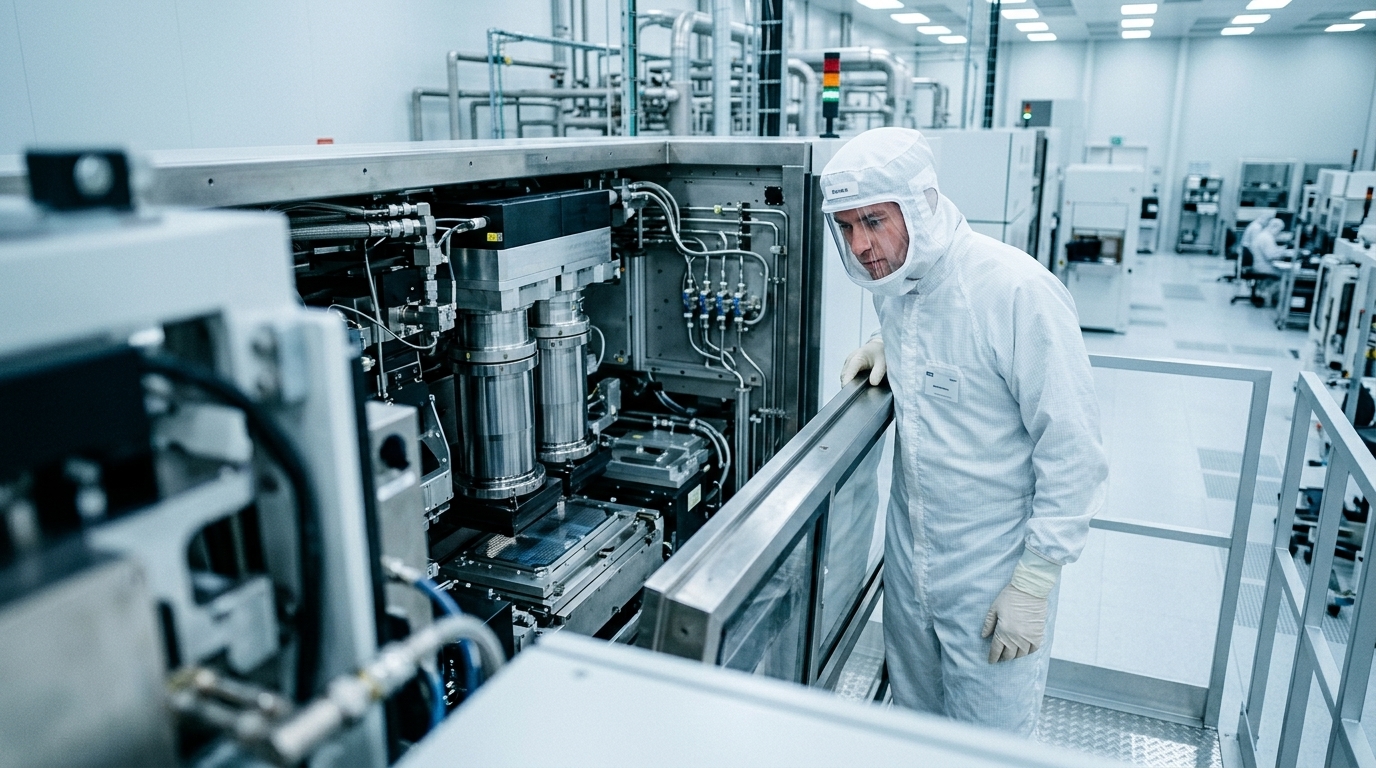
ASML’s dominance is not built on marketing, but on absolute technological superiority. The company holds a global monopoly on the production of Extreme Ultraviolet (EUV) lithography machines. These machines, roughly the size of a double-decker bus and costing upwards of $200 million each, use light with a wavelength of just 13.5 nanometers to "print" billions of transistors onto microscopic silicon wafers.
Without ASML, the production of advanced processors that power iPhones, Nvidia’s AI servers, and supercomputing clusters would grind to a halt. The complexity of these systems is so immense that no competitor—not Japan’s Nikon, nor Canon—has managed to replicate the precision of the Dutch technology. It is a process that requires the orchestration of thousands of suppliers, with lenses from Germany’s Zeiss acting as the "eyes" of these machines in a partnership that has spanned decades.
Financial Triumph and the AI Revolution
The surge in ASML’s stock price through 2025 and 2026 is no accident. The explosion of Artificial Intelligence (AI) has created an insatiable hunger for raw computing power. As companies like OpenAI, Google, and Meta race to train ever-larger language models, the demand for next-generation chips has skyrocketed. This translates directly into massive orders for ASML from the world's leading foundries: TSMC in Taiwan, Samsung in South Korea, and Intel in the United States.
Investors view ASML as a "safe haven" with exceptional margins. Despite geopolitical headwinds, the company maintains a multi-year backlog of orders. The introduction of the new High-NA EUV machines, which promise even greater transistor density, is expected to solidify its dominance for the next decade, making ASML the undisputed gatekeeper of technological progress.
Geopolitics: ASML as Pawn and King
However, ASML’s position at the summit is fraught with risk. The company has found itself at the epicenter of the trade war between the United States and China. Washington, citing national security concerns, has exerted significant pressure on the Dutch government to restrict exports of ASML's most advanced machinery to Beijing. This creates a profound dilemma: China remains a massive market, but dependence on US-patented components and the need for diplomatic alignment force the company to navigate treacherous waters.
For Europe, ASML is the "crown jewel." In a continent often criticized for missing the digital innovation wave led by the US and China, the Dutch firm proves that European engineering and long-term R&D investment can produce global leaders. ASML’s success is not merely financial; it is proof that controlling critical infrastructure offers more leverage than any social network or software platform ever could.
Conclusion: The Future of 700 Billion
As we move into the latter half of the 2020s, the challenge for ASML will be maintaining this blistering pace of innovation. Moving to even smaller scales (sub-2 nanometers) requires billions in investment and solving physical problems that push the boundaries of what is possible. Yet, with a $700 billion valuation as its foundation, ASML is no longer just a supplier; it is the architect of the future, the company that dictates the speed at which human civilization evolves through technology.





