

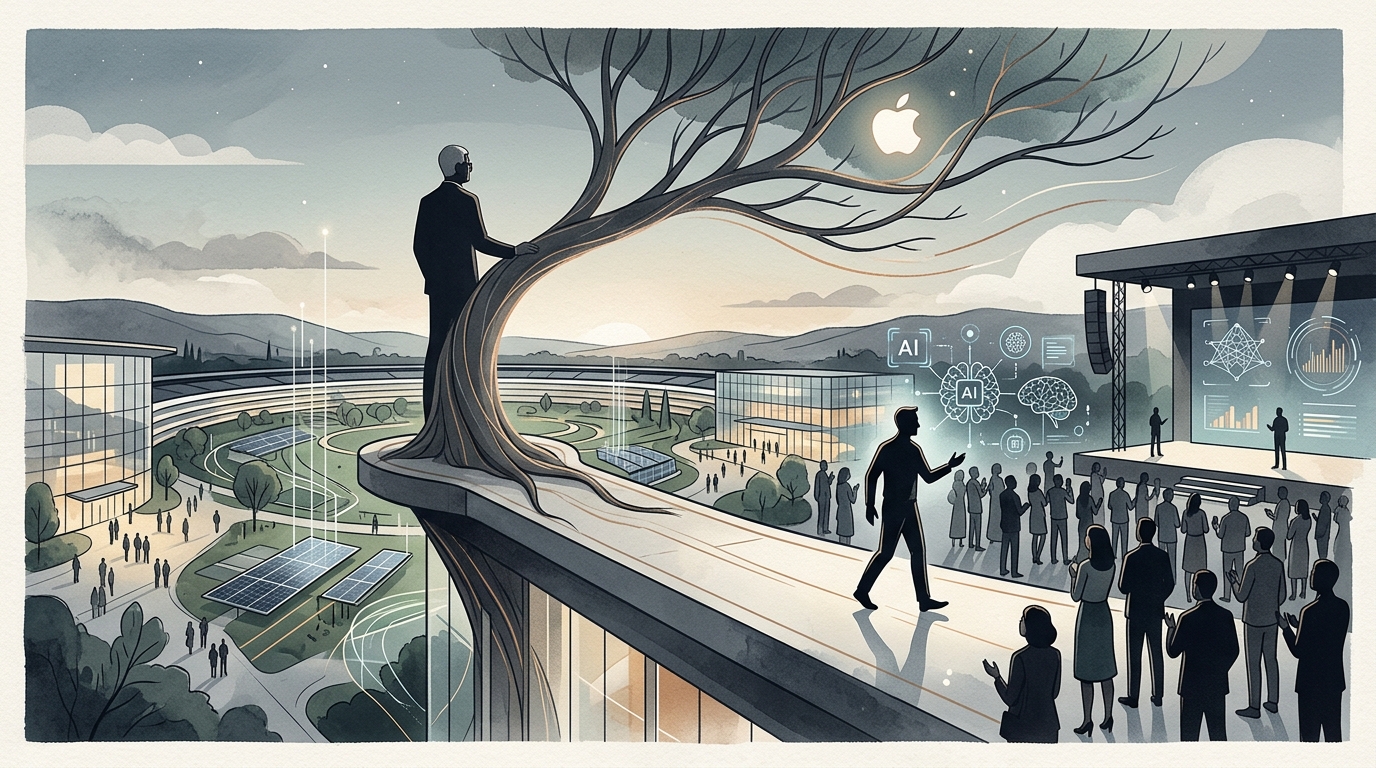
In April 2026, Apple stands at a critical crossroads that many analysts awaited with bated breath, yet few predicted the serenity with which it would unfold. After 15 years at the helm, Tim Cook—the man who transformed Apple from a device company into a $3 trillion+ global economic titan—is passing the torch. His successor, John Ternus, is not a name that grabs headlines with eccentricity, and that is precisely the secret to his ascent.
The Tim Cook Legacy: From Operational Excellence to AI Maturity
When Tim Cook took over in 2011, skeptics were everywhere. He was dismissed as a "bean counter" who would squander Steve Jobs’ creative legacy. Fifteen years later, Cook leaves having achieved the impossible: he increased the company’s market capitalization tenfold, built a services ecosystem generating billions, and most importantly, paved the way for "Apple Intelligence."
Cook’s departure is not a flight under pressure but a carefully orchestrated maneuver. He leaves Apple at a moment when Artificial Intelligence is no longer a promise but the core of every new iPhone, iPad, and Mac. Cook managed to integrate AI in an "Apple way"—focused on privacy and daily utility, avoiding the hype bubbles that ensnared other tech giants.
Why John Ternus is the Chosen One
John Ternus, formerly the Senior Vice President of Hardware Engineering, epitomizes Cupertino’s internal culture. His selection sends a clear message: in the AI era, hardware is just as vital as software. Apple’s AI doesn’t just run in the cloud; it lives within Apple Silicon.
Ternus was the architect of the transition to M-series chips, a move that gave Apple the lead in energy efficiency and processing power required for local AI model execution. He is a leader who understands that AI is not a standalone product but a capability that must be harmoniously integrated into devices that users love to touch and use.
- Stability: Ternus enjoys the absolute trust of the team and shareholders.
- Hardware-First AI: Focusing on on-device processing requires deep knowledge of silicon.
- Generational Renewal: At 50, Ternus offers a long-term leadership perspective for the next two decades.
The AI Challenge and Competition
Despite the smooth transition, the road is not without hurdles. Microsoft, Google, and Meta have invested billions in Generative AI. The challenge for Ternus will be balancing innovation with Apple’s strict data protection policies. Critics argue Apple was late to the AI dance, but history has shown the company prefers to be the best rather than the first.
"John is one of the most capable leaders I’ve ever met. He understands Apple’s DNA at a cellular level," Cook stated in a recent interview.
The market may have reacted with a slight dip in stock price due to the uncertainty any leadership change brings, but long-term investors see the big picture. Apple isn’t changing direction; it’s changing gears. With Ternus, the company is ready to transform the iPhone from a "smartphone" into a personal digital companion that anticipates user needs without violating privacy.
The Future: From iPhone to Spatial Computing
Ternus’s tenure will also be judged by the success of Vision Pro and its subsequent iterations. AI is the connective tissue that will make Spatial Computing accessible to the masses. If Cook was the CEO of "supply chains and services," Ternus is tasked with being the CEO of "unified intelligence." Apple is entering a new golden age where technology becomes invisible and the user experience becomes absolute.





