

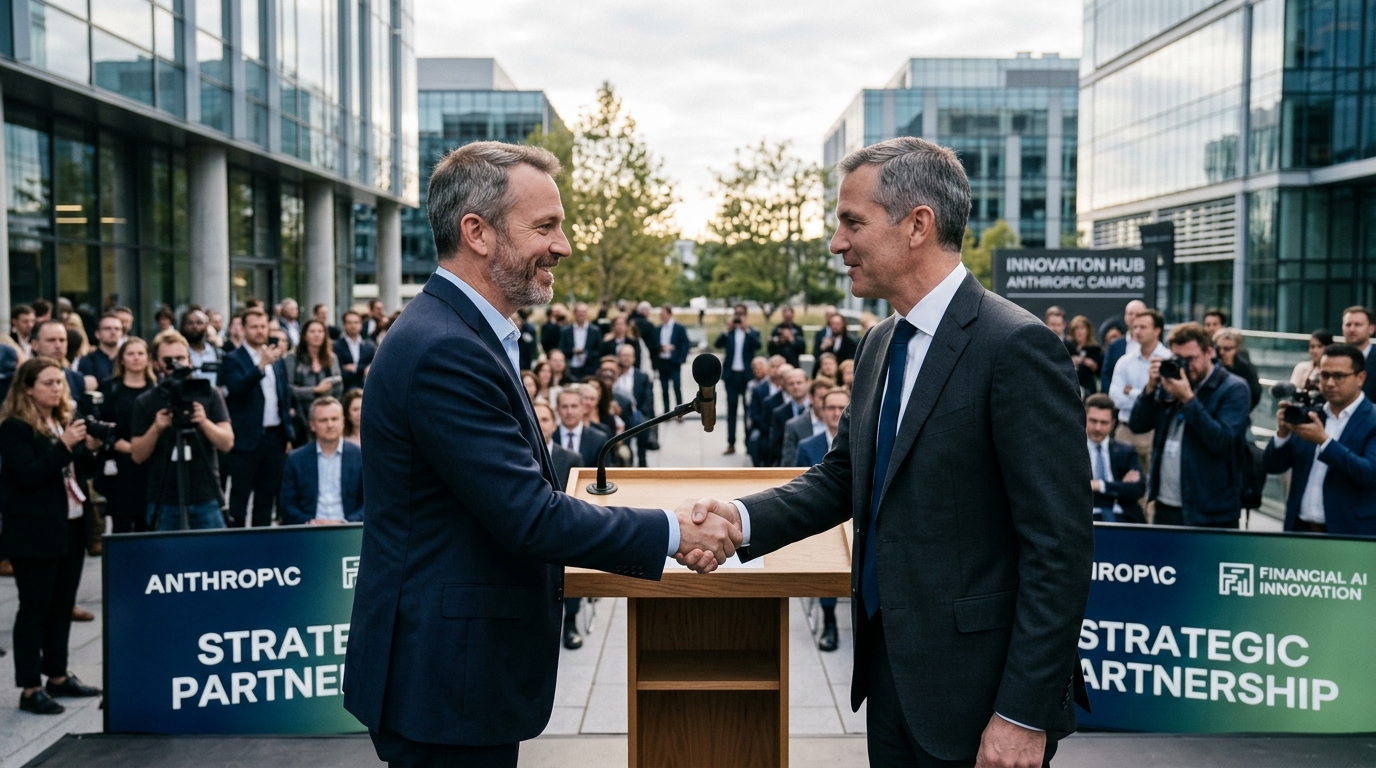
In a move poised to reshape the landscape of artificial intelligence, Anthropic, the developer of the Claude AI models, is reportedly in advanced talks to establish a $1.5 billion joint venture with major Wall Street firms. As reported by the Wall Street Journal and Reuters, this strategic alliance transcends mere capital infusion, signaling a deep integration of "Constitutional AI" into the bedrock of global financial markets.
The Rationale: Constitutional AI Meets High Finance
Anthropic, founded by former OpenAI executives, has built its reputation on safety and ethical alignment. For Wall Street institutions, these attributes are not just theoretical virtues but operational imperatives. In an industry where a single algorithmic error can lead to billions in losses or trigger severe regulatory sanctions, Anthropic’s controlled, rules-based approach offers a compelling alternative to the more unpredictable models of its competitors.
The joint venture is expected to focus on developing specialized AI tools for risk assessment, high-frequency trading optimization, and sophisticated wealth management. Wall Street has long sought to harness Large Language Models (LLMs) to process vast quantities of unstructured data—from earnings call transcripts to complex geopolitical shifts—in real-time. Through this deal, Anthropic gains access to high-fidelity financial data, while the banks secure a "walled garden" AI environment tailored to their specific compliance needs.
The Battle for Compute and Data Dominance
This development arrives as the cost of training frontier models reaches unprecedented levels. The $1.5 billion injection will allow Anthropic to secure the necessary compute resources from providers like Amazon and Google, who are already major stakeholders. However, by diversifying its investor base with Wall Street titans, Anthropic is signaling a strategic desire to balance the influence of Big Tech.
- Liquidity boost for the development of Claude 4 and beyond.
- Exclusive access for banking partners to customized APIs.
- Reduction of "hallucination" risks through training on curated financial datasets.
- Establishment of new AI-driven compliance standards.
Wall Street is not merely investing in a company; it is investing in an infrastructure. If Anthropic manages to become the "operating system" of modern finance, its valuation could skyrocket, placing it in direct competition with the OpenAI-Microsoft monolith.
Systemic Risks and Regulatory Oversight
Despite the optimistic outlook, the partnership carries significant risks. Regulators in the US and the EU are increasingly wary of power concentration in the AI sector. Utilizing AI for decision-making in critical financial infrastructure raises questions about transparency and systemic stability. A primary concern is the "monoculture" risk: if multiple financial giants rely on the same Anthropic model, any inherent bias or failure within that model could propagate across the entire financial system simultaneously.
"AI on Wall Street is no longer an experiment; it is the new battlefield for market supremacy," notes a senior market analyst.
Anthropic must now prove that its "Constitutional" framework can withstand the relentless pressure of market demands for immediate returns. The tension between ethical safety and aggressive financial performance will be the defining challenge of this venture. As we move further into 2026, the success of this partnership will determine whether AI remains a supportive tool or becomes the central pillar of global capitalism.





