

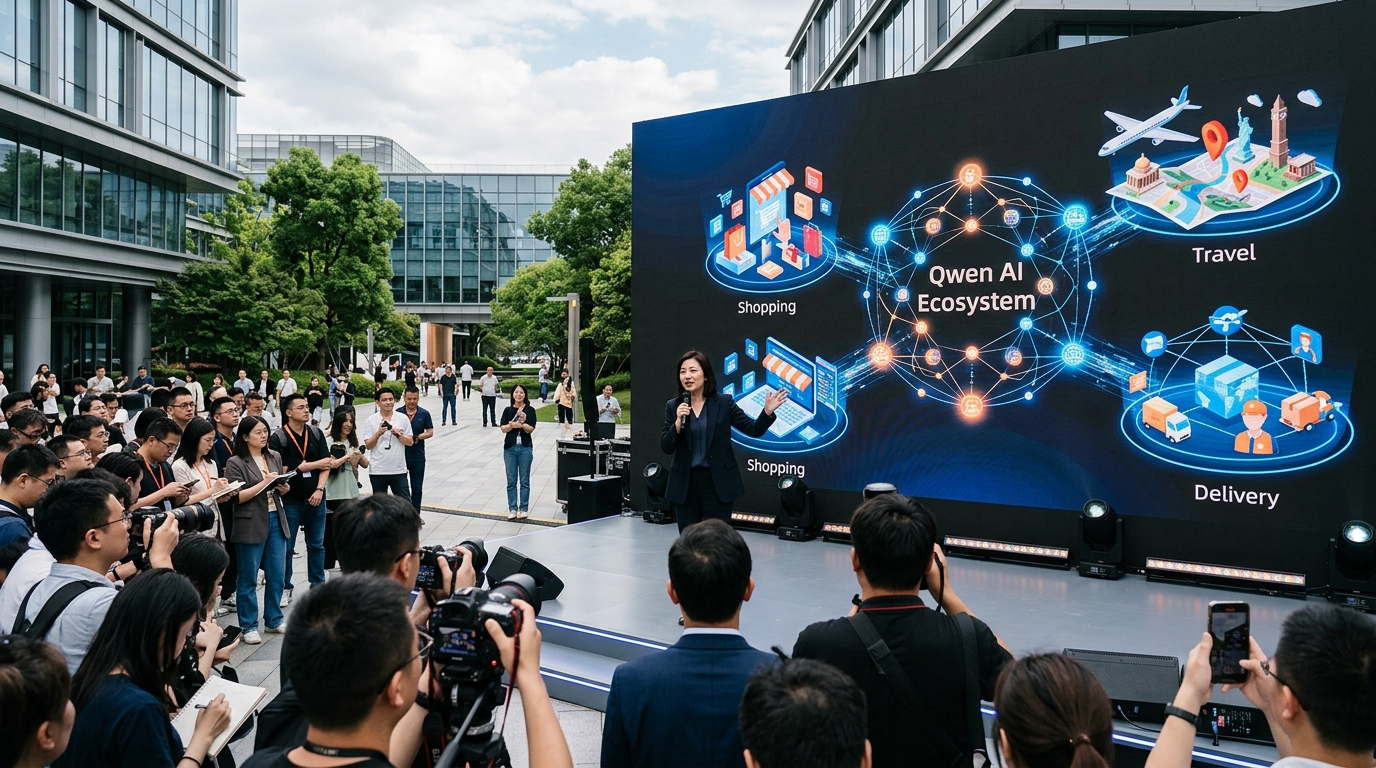
In a move set to redefine the landscape of the global digital economy, Alibaba Group Holding Ltd. has announced the deep integration of its flagship services—including e-commerce, food delivery, and travel bookings—directly into its Qwen (Tongyi Qianwen) AI platform. This development marks a pivotal shift from the era of "apps" to the era of "AI agents," where users no longer navigate through menus but interact with a centralized intelligence that executes complex tasks on their behalf.
The AI Super-App Strategy
Alibaba is no longer treating Qwen as a secondary productivity tool; it is now the connective tissue of its entire ecosystem. By integrating Taobao (e-commerce), Ele.me (food delivery), and Fliggy (travel services), the company is creating a holistic user experience. For instance, a user can now prompt Qwen: "Plan a three-day trip to Shanghai on a $500 budget, book the flights, and order a light meal for when I arrive at the hotel." The AI will not just provide information; it will execute the transactions.
This approach echoes the "Super App" vision pioneered by WeChat, but with a critical distinction: the use of Large Language Models (LLMs) to understand human intent naturally. Alibaba is betting that seamless convenience will be the ultimate competitive advantage in the saturated Chinese market.
Competition and Technological Edge
This move comes at a time when Chinese tech giants like Baidu (with Ernie Bot) and Tencent (with Hunyuan) are locked in a fierce battle for AI supremacy. However, Alibaba possesses an advantage that others struggle to match: a vast repository of transactional and supply chain data. The integration of Cainiao’s logistics allows Qwen to track orders in real-time, offering a level of utility that goes far beyond a simple digital assistant.
"We are not just building a chatbot; we are building the operating system for the future economy," an Alibaba executive stated during the strategy unveiling.
The technological foundation of Qwen has also been upgraded to feature multimodal capabilities. This means the system can analyze product images, compare prices across different platforms, and suggest alternatives based on the user's visual preferences or past purchasing habits.
Challenges and Regulatory Hurdles
Despite the technological euphoria, Alibaba faces significant obstacles. The foremost is China’s stringent regulatory environment regarding data management and AI ethics. The Chinese government closely monitors how LLMs influence public opinion and handle citizen data. Furthermore, consumer trust is paramount; delegating purchasing power to an algorithm requires high levels of transparency and security.
Additionally, there is the concern of "vendor lock-in." By consolidating all services under Qwen, Alibaba is attempting to keep users within its own ecosystem, making it difficult for them to switch to competing platforms. This could potentially trigger new antitrust investigations, an area where the company has had painful experiences in the recent past.
The Future of AI-Commerce
The integration of Qwen is a precursor to what analysts are calling "AI-Commerce." In this model, the traditional product search is becoming obsolete. AI predicts needs, suggests solutions, and completes the process without requiring multiple clicks. For Alibaba, this is the only path to reclaiming its market valuation and proving to investors that it remains at the cutting edge of innovation, despite geopolitical pressures and internal leadership changes.
In conclusion, Alibaba's move to transform Qwen into a "portal for everything" is more than just a technical upgrade. It is a strategic statement about what life in the 21st century will look like: a constant interaction with an invisible, intelligent intermediary that knows our preferences better than we do ourselves.





