

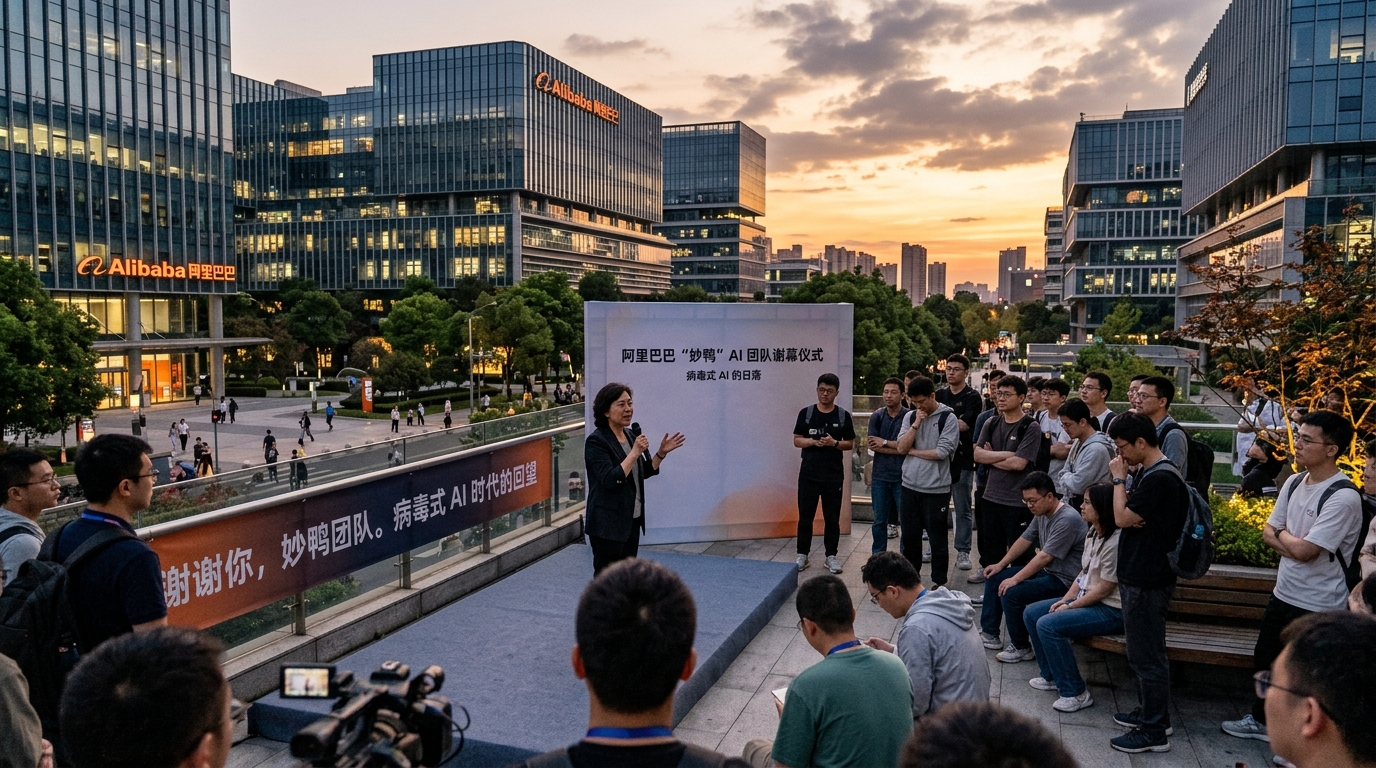
In the summer of 2023, China witnessed a digital frenzy reminiscent of the early days of Instagram. The app Miaoya (meaning 'Wonderful Duck'), a mini-program embedded within the Alibaba ecosystem, became the ultimate symbol of consumer-facing Generative AI. For just 9.9 yuan (approximately $1.40), users could generate professional-grade portraits that rivaled those of expensive photo studios. However, news reported by Yicai Global regarding the disbanding of the team behind the app confirms a harsh reality: in the world of AI, viral success does not guarantee long-term viability.
The Rise and the Sudden Descent
Miaoya was not just an app; it was a demonstration of Alibaba's prowess in consumer software. Developed by the group's digital entertainment unit (under the Damai and Youku umbrella), it managed to amass millions of users in just a few weeks. Its technology was based on fine-tuning open-source models, allowing for the generation of high-quality images with minimal user effort. Despite the initial success, user retention proved to be its Achilles' heel. Much like the Lensa app in the West, once the novelty faded, users stopped paying for a service they felt they had already exhausted.
Alibaba's Strategic Restructuring
The decision to disband the team should not be viewed in isolation. Alibaba is in the midst of a historic restructuring, splitting its empire into six distinct business units. Within this framework, efficiency and profitability have become the absolute priorities. Miaoya, while communicatively successful, required massive resources in computing power (GPU clusters) to process images, while micro-transaction revenues were insufficient to cover costs in the long run. According to insiders, team members will be absorbed into other Alibaba departments, likely in cloud computing or e-commerce, where AI can yield direct financial benefits.
- The staff relocation indicates a shift toward integrating AI into existing platforms like Taobao and Tmall.
- GPU costs remain prohibitive for 'light' apps without a stable subscription model.
- The Chinese AI market is shifting from 'toys' to productivity applications for enterprises.
A Lesson for the AI Ecosystem
The Miaoya case serves as a warning signal for investors and app developers worldwide. The 'attention economy' is extremely volatile in the AI sector. Users are constantly searching for the next impressive tool, but very few of these become part of their daily lives. For Chinese giants like Tencent, Baidu, and ByteDance, the challenge is now to create 'killer apps' that have utility beyond mere entertainment. Alibaba seems to recognize that the true value of artificial intelligence lies not in standalone apps, but in the infrastructure that supports them and the tools that enhance business productivity.
"Artificial intelligence is no longer a laboratory experiment, but a race for the survival of the fittest in the market," says a Shanghai-based industry analyst.
In conclusion, the disbanding of the Miaoya team marks the end of the 'romantic' AI period in China. Companies are entering a phase of maturity where every investment must be justified by clear performance indicators. Miaoya may disappear as a standalone brand, but the technology it developed will live on within the code of Alibaba's larger platforms, now serving more mundane but profitable purposes.





