

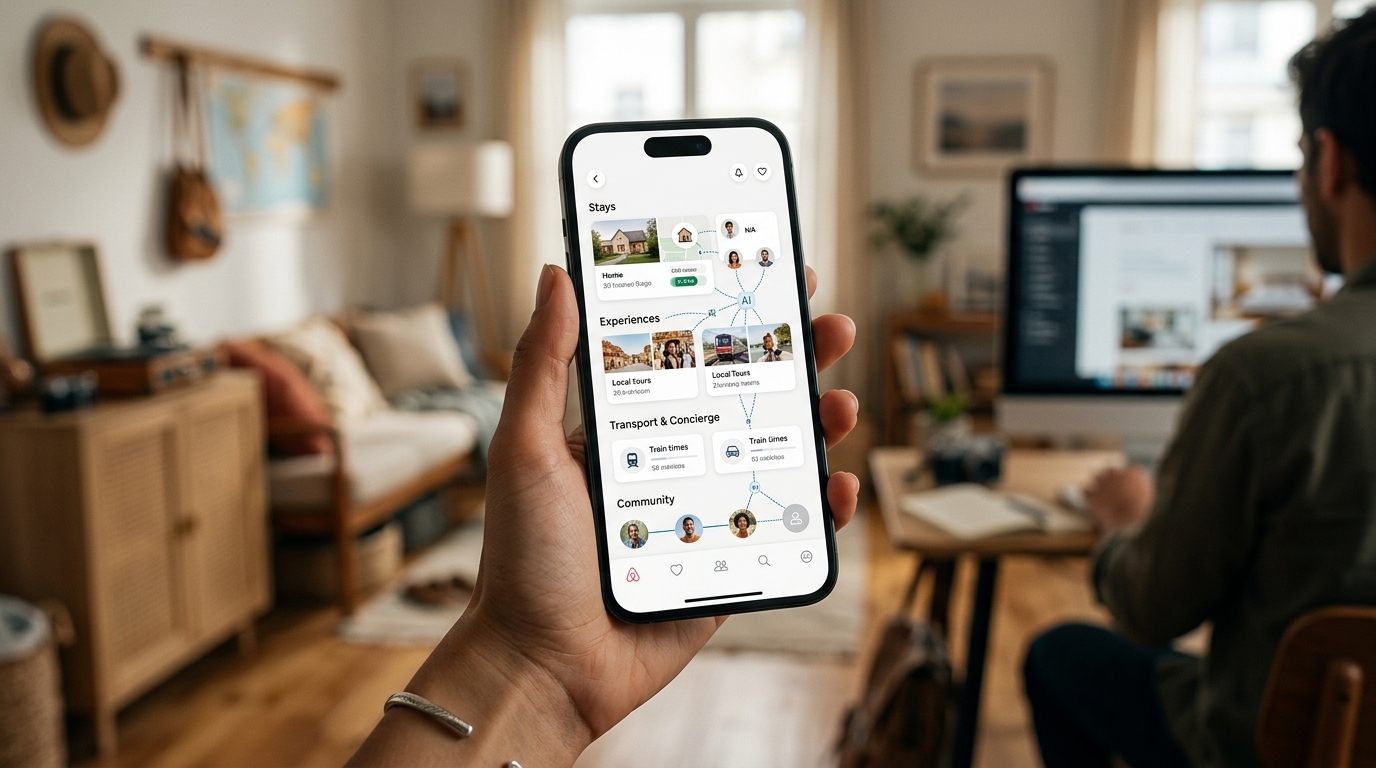
Airbnb is currently navigating its most ambitious phase since its inception in 2008. What began as a simple idea to rent out an air mattress in a San Francisco apartment is evolving into a comprehensive travel titan aiming to control every facet of the user experience. CEO Brian Chesky has made it clear that Airbnb can no longer be limited to lodging alone. The new "all-inclusive" strategy aims to create an ecosystem where Artificial Intelligence (AI) acts as the ultimate digital concierge, seamlessly connecting accommodation with transportation, activities, and hyper-personalized experiences.
Artificial Intelligence: The Backbone of a New Era
Generative AI is not merely an add-on feature for Airbnb; it is the core of its structural reorganization. The company is investing billions into developing models capable of understanding user preferences with a depth that far exceeds traditional search filters. In the near future, searching for a "house in Crete" will be replaced by a conversation with an AI assistant that knows whether the user prefers tranquility, is traveling with children, or is seeking specific culinary experiences, suggesting not just the right stay but a complete, curated itinerary.
According to Chesky, AI will enable Airbnb to offer "five-star concierge services" at a scale of millions of users. This includes automated dispute resolution between guests and hosts, real-time price optimization, and the use of computer vision to verify listing photos, drastically reducing fraud and improving trust within the community.
Strategic Expansion: FIFA World Cup 2026 and Icons
One of the company's biggest upcoming milestones is the 2026 FIFA World Cup, set to take place across the USA, Canada, and Mexico. Airbnb is preparing to absorb the massive surge of tourists by offering housing solutions in cities where hotels are expected to be fully booked months in advance. Collaborating with local authorities and boosting supply in these regions is a top priority, as the company seeks to prove it can manage global events of this magnitude with greater flexibility than the traditional hotel industry.
Simultaneously, the introduction of the "Icons" category marks Airbnb's entry into the premium experience market. From stays in world-renowned museums and iconic buildings to meet-and-greets with celebrities, the company is striving to create a "halo effect" to elevate its brand. These experiences aren't just about direct profit; they are designed to generate social media buzz, reinforcing Airbnb's image as a platform that sells memories rather than just square footage.
Challenges and the Regulatory Landscape
Despite the optimism, the path to total transformation is fraught with obstacles. Airbnb faces mounting pressure from cities like Athens, Barcelona, and New York, which accuse the platform of driving up rents and eroding the social fabric of local neighborhoods. The company's AI-driven response includes tools for better monitoring of unauthorized parties and noise pollution, as well as systems that help hosts comply more easily with complex local regulations.
"We don't want to just be an app you use once a year. We want to be your travel companion for every day of your trip," Chesky recently stated.
The shift to an all-inclusive model also means direct competition with giants like Booking.com and Expedia, which have already integrated flights and car rentals into their ecosystems. Airbnb is betting on the uniqueness of its inventory and a superior, AI-powered user experience (UX) to win this market share battle.
The Future: From Software to Services
The ultimate goal is for Airbnb to become a "service platform." This could encompass everything from providing AI-assisted local guides to integrating transportation and dining services directly within the app. The use of AI will allow the company to operate with lower overhead while increasing revenue per user through cross-selling. For investors, this transformation promises higher profit margins and a more stable revenue stream that isn't solely dependent on seasonal lodging bookings. As the boundaries between technology and hospitality blur, Airbnb is positioning itself to be the operating system for global travel.





