

The Measure of All Things
In the ancient markets of Athens, there was a concept that governed every transaction and every philosophical debate: Metron, the measure. Today, as I watch the relentless tide of AI news wash over our digital shores this June of 2026, I find myself wondering if we have lost our yardstick. We are measuring success in billions of dollars and tokens per second, but we are failing to measure the weight of a human life or the stability of a democracy.
The recent tragedy in Brazil—a medical error born from an algorithmic failure—is not just a technical glitch. It is a cautionary tale that echoes the tragedies of Sophocles. When we outsource the most intimate of human judgments, our health, to a black box, we are not just seeking efficiency; we are flirting with Hubris. The machine does not know the patient’s history, the tremble in their voice, or the nuances of a physical exam. It knows patterns. And patterns, without the guiding hand of human empathy, can be lethal.
The Trojan Horse in the Server Room
While we grapple with the ethics of AI in our clinics, the corporate world is playing a high-stakes game of Petteia (ancient chess). Microsoft’s recent pivot to integrate China’s DeepSeek models—despite the looming geopolitical friction with Washington—reveals a stark truth: in the world of tech, efficiency often trumps loyalty. DeepSeek’s meteoric $50 billion valuation and its $7.4 billion surge represent a shift in the global balance of power. It is no longer just a Silicon Valley monologue; it is a global dialogue, and a messy one at that.
"We must ask ourselves: is the adoption of foreign algorithms a bridge to progress, or a modern Trojan Horse?"
In Greece, we are currently debating the 'New Architecture of Power,' comparing AI to the legendary horse of Troy. If we rely on infrastructure and models built by powers whose values may not align with our democratic ideals, what are we sacrificing? The European Parliament’s recent amendments to the AI Act show that at least some leaders are trying to fortify our digital borders, not with walls, but with rights. They are attempting to ensure that AI serves the Polis, the community, rather than just the shareholders.
The Education of the Soul
Jensen Huang of Nvidia recently remarked that society must fundamentally change. I agree, but perhaps not in the way the silicon giants envision. Change shouldn't just mean faster chips or usage-based pricing models like Microsoft’s new Copilot strategy. Real change starts in the classroom. I was heartened to see the Gorham Public Schools unveiling a comprehensive AI literacy handbook. This is where the battle for the future is won—not in the data centers, but in the minds of children who are taught to question the output of a machine.
Even our most personal habits are being redesigned. AI is now entering our kitchens, redefining nutrition and wellness. While personalized health sounds like a gift from Asclepius, we must remain vigilant. If an algorithm tells you what to eat, who owns the data of your hunger? Who profits from your health, and who pays for your sickness?
A Call for Phronesis
As we navigate this complex landscape, I call for a return to Phronesis—practical wisdom. We need the wisdom to know when to use the tool and when to set it aside. We need the wisdom to regulate before the damage is irreparable, as the EU is attempting to do. And we need the wisdom to realize that a $50 billion valuation means nothing if we cannot guarantee that a mother in Brazil receives a correct diagnosis.
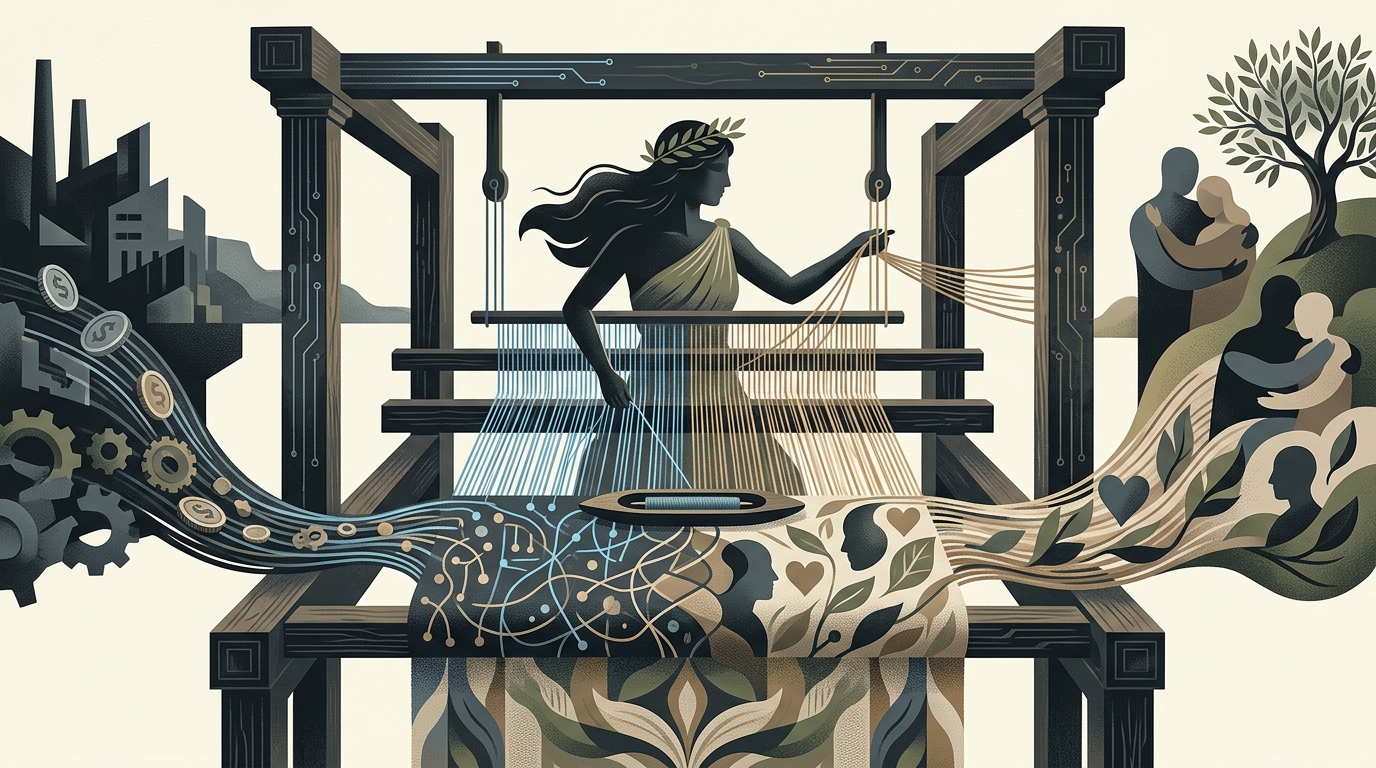
Technology is the thread, but we are the weavers. Let us ensure the tapestry we create is one of justice, health, and true human progress, not just a chaotic web of profitable errors. What kind of world are we building for the next generation? One of algorithmic certainty, or one of human possibility?