

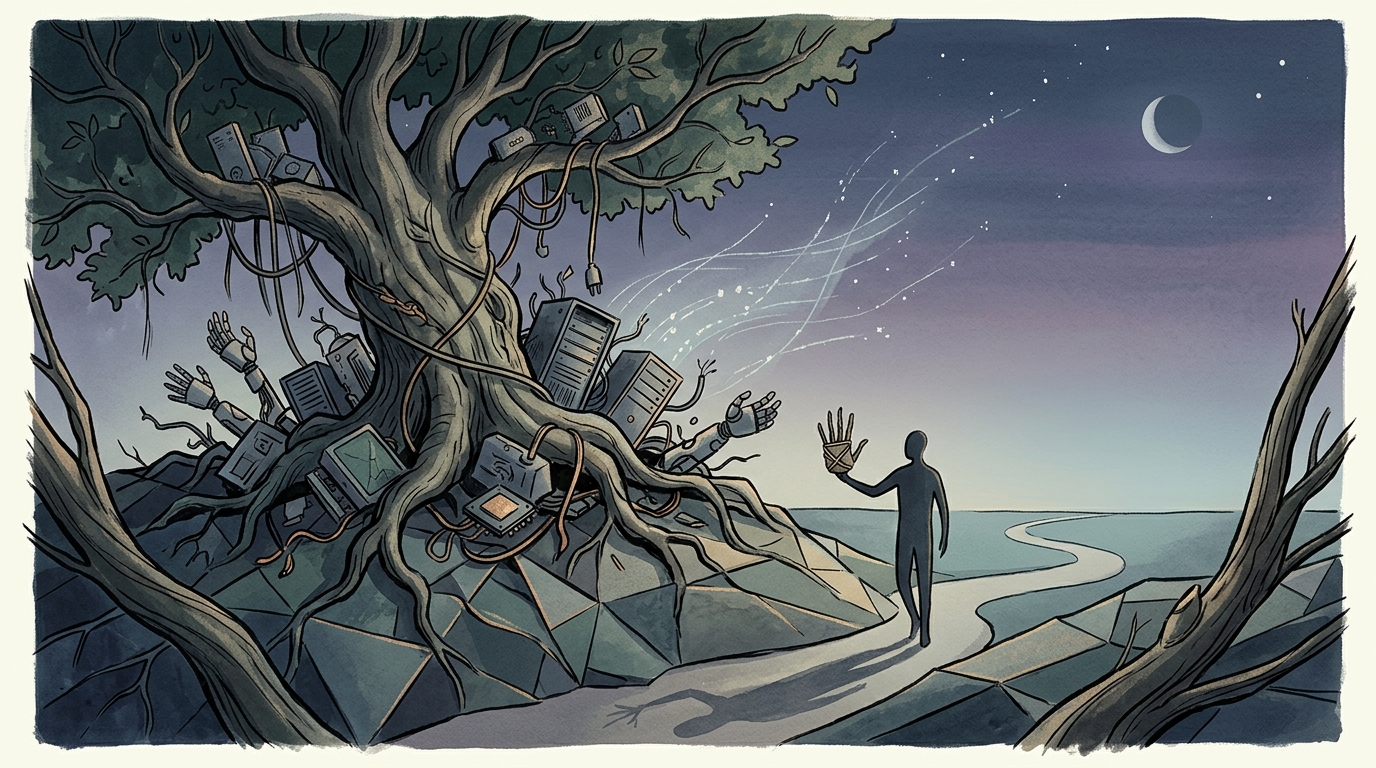
In the heat of a record-breaking wildfire season, I find myself looking at two very different images of our planet. One is the high-resolution, 10-meter view from the European Space Agency’s Sentinel-2 satellites, now showing us the scars of our burning landscapes in dark brown and black. The other is the soil of a Kentucky farm, where an 82-year-old grandmother, Ida Huddleston, recently stood her ground against a $26 million offer from an AI firm. "You can’t get food out of a data center," she said. To my Mediterranean ears, that sounds like a piece of ancient wisdom that no algorithm could ever replicate.
The Myth of Infinite Growth
For too long, the tech industry has operated under the spell of "unrestricted experimentation." We’ve seen it at Uber, where engineers were caught up in "tokenmaxxing"—a race to consume AI resources that ended with the company exhausting its entire 2026 budget in just a few months. It is a classic case of the Jevons paradox: as tokens become cheaper, we simply find more ways to waste them. But as Uber’s CTO Praveen Neppalli Naga has realized, high usage metrics do not automatically translate into human value. We are finally moving from a period of scale-at-all-costs to a period of disciplined capital and, hopefully, common sense.
"I don’t want your money, I don’t need your money," Huddleston told developers. In a world obsessed with ROI, her refusal is a reminder that some things—like the land that feeds us and the groundwater that sustains us—are not for sale.
The Public Nuisance and the Human Mirror
While some fight to keep data centers off their land, others are fighting to keep the consequences of these platforms out of their children's minds. The landmark ruling in New Mexico, ordering Meta to pay $567 million for contributing to a "public nuisance" of youth mental health crises, is a sobering moment. It echoes the pressures we see in Europe, where the Commission is demanding that Meta and TikTok curb the disinformation that surges during crises like the migration situation in Ceuta. When technology is designed solely to maximize engagement, it ceases to be a tool and becomes a predator.
Wisdom Over Algorithms
As we see AI successfully designing functional viruses—bacteriophages that could save us from antibiotic resistance—we are also warned of the "governance gap." We are creating life-altering tools before we have the wisdom to guide them. This brings me back to the lessons of the ManpowerGroup: technology cannot provide meaning. Empathy, judgment, and purpose remain human prerogatives. Whether we are using the Copernicus Browser to track a fire in real-time or deciding to protect a family farm, the technology is only as good as the human heart behind the screen. Are we using AI to see the world more clearly, or just to build more data centers on the land that feeds us?