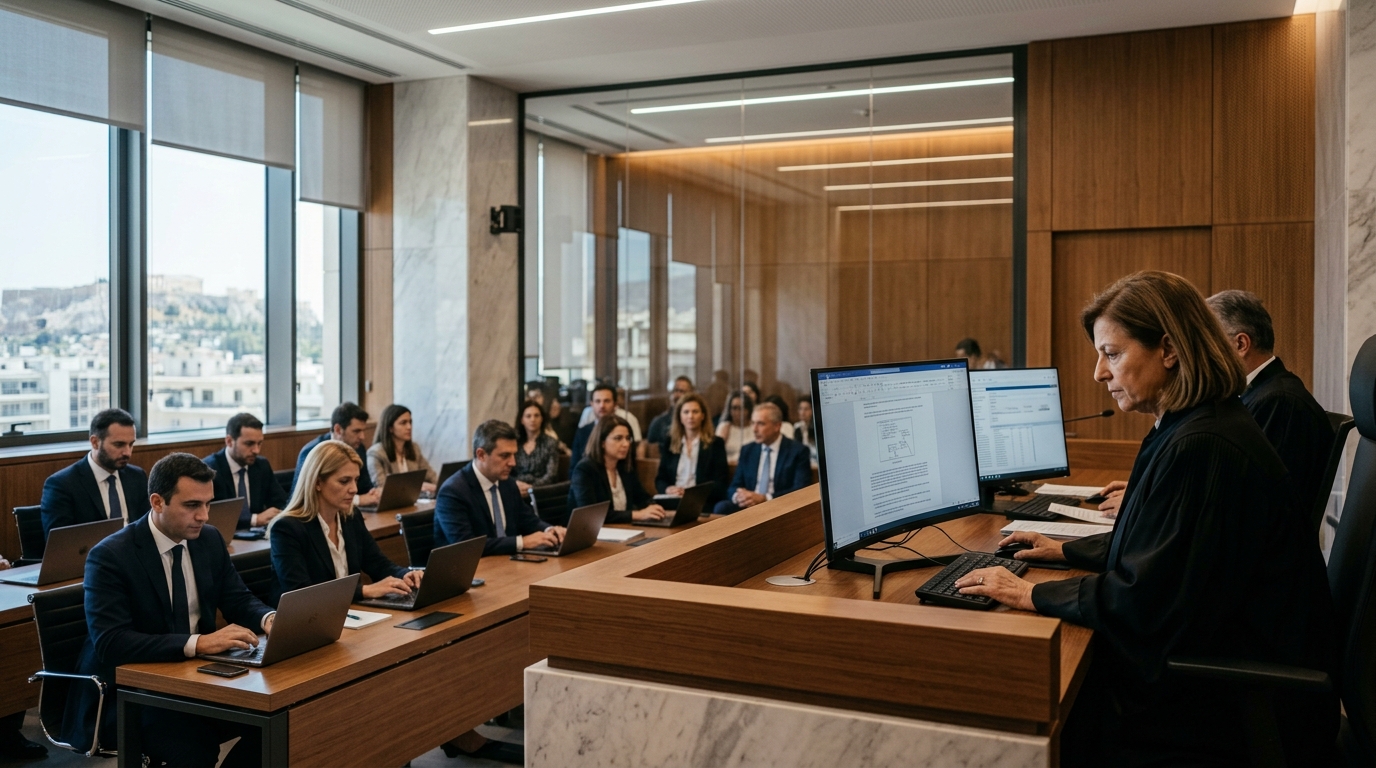
Greek Justice, an institution often criticized for its labyrinthine procedures and chronic delays, is on the threshold of a historic transformation. The Athens Court of Appeal, the heart of the country's judicial system located on Loukareos Street, is set to become the focal point of an ambitious modernization program. Recent announcements from the Ministry of Justice do not merely concern a superficial renovation but a structural reboot that combines cutting-edge technology with the upgrade of physical space.
Artificial Intelligence in the Service of Themis
The most radical change involves the integration of Artificial Intelligence (AI) tools into the daily operation of the courts. This is not about replacing judges with algorithms, but about providing "smart" tools that will drastically reduce the time required for case preparation and processing. According to the plan, AI will be used for real-time automated transcription of court proceedings, eliminating the months-long wait for the drafting of decisions. Furthermore, advanced Natural Language Processing (NLP) systems will assist judicial officers in legal research, identifying similar cases and legal precedents from thousands of digitized documents in seconds.
The application of AI also extends to case flow management. The ability to predict workload and the automated categorization of documents is expected to decongest administrative offices, allowing human personnel to focus on higher-value tasks. The digitization of archives, which is already underway, forms the foundation upon which these models will run, turning the Court of Appeal into a truly digital ecosystem.
Radical Renovation: A Modern Environment for the Rule of Law
Alongside the digital upgrade, the Athens Court of Appeal building will undergo a radical renovation. The project, largely funded by the Recovery and Resilience Facility (RRF), aims to improve accessibility, energy efficiency, and the functionality of the spaces. Courtrooms will be equipped with modern audiovisual means, allowing for the seamless conduct of remote trials and the digital display of evidence.
The aesthetic and functional upgrade of the Loukareos building also carries symbolic weight. A modern, clean, and technologically advanced environment inspires greater confidence in citizens and improves working conditions for judges, lawyers, and judicial clerks. The creation of new waiting areas and improved signage will make the Court of Appeal more citizen-friendly, reducing the frustration that often accompanies legal disputes.
The Goal of Faster Delivery: A Necessity for Society and the Economy
The great challenge remains speed. Greece consistently ranks among the last in the European Union regarding the time taken to issue final judicial decisions. This delay is not just a justice problem but also a significant barrier to economic growth, as it deters investment and creates a sense of legal uncertainty. The changes at the Athens Court of Appeal aim to reduce trial times by at least 30% within the next two years.
However, the challenge is immense. The success of the venture depends on staff training and the acceptance of new technologies by the legal community. The transition from paper to screen requires a change in mindset. Bar associations have already expressed their interest, while also requesting safeguards for the protection of personal data and the maintenance of human judgment as the ultimate arbiter of justice. Artificial Intelligence must remain an assistant, not a replacement, ensuring that the "soul" of justice remains human.
Conclusion
The announcement regarding the Athens Court of Appeal marks the beginning of the end for an era of bureaucracy and delays. With the support of Artificial Intelligence and the creation of modern infrastructure, Greek Justice is attempting a leap into the future. If the Loukareos experiment succeeds, it will serve as the blueprint for all the country's courts, offering Greek citizens what they deserve: a fair trial within a reasonable timeframe.