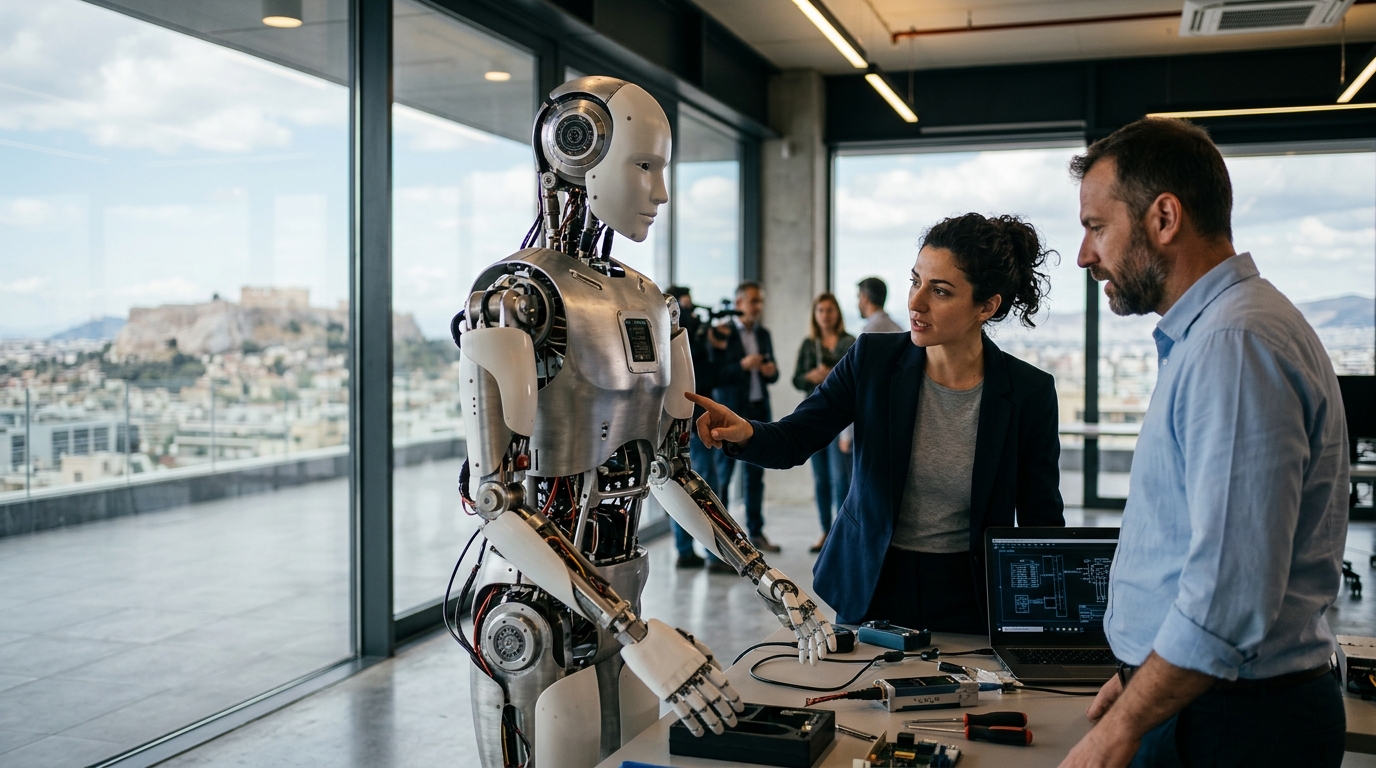
For decades, Artificial Intelligence remained confined to screens and servers—an intangible entity capable of processing vast amounts of data but unable to touch the physical world. Today, in mid-2026, we are witnessing the great transition to "Embodied AI." Artificial Intelligence is no longer content with writing essays or generating images; it is gaining arms, legs, and sensors. At the heart of this global technological race stands a Greek company making waves: Aperion Robotics.
Aperion Robotics, led by George Kontoudis, is not just another startup. It represents a Greece that does not merely consume technology but creates it. The company focuses on developing robotic systems that utilize advanced foundation models to understand their environment and perform complex tasks in real-time, bridging the gap between the digital and physical realms.
The Embodied AI Revolution
The fundamental difference between traditional robotics and embodied AI lies in autonomy and adaptability. While older robots were programmed for specific, repetitive motions, Aperion’s systems "learn" through experience. Using reinforcement learning techniques and advanced computer vision, these robots can navigate unstructured environments—from warehouses and factories to hospitals—without the need for constant human guidance.
Aperion’s approach is rooted in the idea that intelligence requires interaction with matter. Much like a child learns the laws of physics by dropping objects, Aperion’s algorithms are trained in simulations across billions of cycles before being transferred to the robot's physical "body." This process enables the creation of machines that can handle delicate objects or work safely alongside human employees.
Greece as a High-Tech Hub
The rise of Aperion Robotics comes at a critical juncture for the Greek economy. After years of "brain drain," we are now seeing a reverse trend. The company has successfully attracted talent from top international universities, creating an innovation ecosystem in Athens. The strategic importance of this development is immense, as robotics constitutes one of the pillars of the Fourth Industrial Revolution.
- Development of Domestic Expertise: Creating both hardware and software in Greece reduces reliance on foreign suppliers.
- Attracting Investment: Aperion has already garnered interest from international venture capital (VC) firms, putting Greece on the deep tech map.
- Academic Synergies: Connecting research from the National Technical University of Athens and other institutions with the labor market is finally becoming a reality.
Challenges and Ethical Dilemmas
Despite the excitement, the path toward mass robot adoption is not without obstacles. High production costs, energy autonomy for machines, and the need for a robust regulatory framework are issues that Aperion and the industry at large must address. Furthermore, social acceptance remains a pivotal question: How ready are we to share public spaces with autonomous machines?
"Robotics is not about replacing humans, but about enhancing their capabilities in environments that are dangerous or tedious," company executives state.
Aperion Robotics is investing heavily in safety and "Explainable AI" (XAI), ensuring that robot decisions are understandable to human operators. This transparency is essential for building trust, particularly in sectors like healthcare and logistics.
The Future: From Greece to the World
Aperion Robotics' vision extends far beyond Greek borders. It aims to become a leader in European robotics, offering solutions that respect strict EU standards for data protection and AI ethics. In a world where the US and China dominate the digital space, embodied AI offers Europe—and Greece in particular—an opportunity to assert its technological sovereignty.
In conclusion, Aperion Robotics proves that innovation knows no geographical boundaries. With Artificial Intelligence finally gaining a body, Greece is at the forefront, ready to shape the future of work, production, and daily life. The challenge now lies in scaling these solutions and integrating them into an economy hungry for modernization.